Simon Taylor
Enter password
Press ↵ to enter

00

Simon Taylor — creative technologist building original IP, audio products & generative tooling.

01 SALIX Transmedia IP · XR · Narrative Systems 2026 02 District Vision × New Balance Audio Product · Wellness · Running 2023 → 2024 03 Burnley FC Creative Operations · Football Culture 2024 04 MusicGen LoRA Music-AI · Artist Model Behavior 2026 05 Next Five Aesthetics Cultural Forecasting · Data System 2026 → 2042 06 Composition Commercials · Songwriting · Films 2007 → 2026

Hiring thesis · one person, six proof systems

I build cultural technology for tools and worlds that need to feel human, mythic, and usable.

This is not a linear design portfolio. It is a set of receipts: public cultural work, original IP, AI-native prototyping, audio product design, artist-led institution building, predictive aesthetics, and body-based endurance systems. The common thread is making new systems legible before they become familiar.

Public cultural signalKlaxons, Mercury Prize, Ivor Novello nomination, three Universal albums, and roughly 500M streams.
World-building engineSALIX: solo transmedia IP across novel, poetry, Unity VR, Wwise spatial audio, voice, score, and generated visual systems.
Artist-model behaviorMusicGen LoRA: Meta's 2.03B model fine-tuned on 2,779 clips from my own catalogue across 26 Kaggle versions.
Wellness audio productDistrict Vision x New Balance: first paid audio product, guided meditation and running modes, acquired into NB mental-health programming.
Mass culture institutionBurnley FC: idiosyncratic artist-led creative operations inside a Premier League football club.
Forecasting systemNext Five Aesthetics: 5,395 CARI artifacts, 1,266 institutional exhibitions, 38 categories, 10 movements, 2026-2042.
AI experience design Product creative Music-AI / creator tools Audio wellness / sport Spatial / XR prototypes Cultural forecasting 2:47 marathon discipline
01 Audio Strategy

District
Vision ×
New Balance

Audio Strategy & Creative Lead · 2023–2024

Recorded, assembled and shipped the brand's first paid audio product — a 16-part course introducing meditation and breathwork as tools for performance gains in distance running. First-of-its-kind part-seated, part-guided-running course. Acquired by New Balance into an ongoing mental health series.

16
Audio Episodes
2
Modes · Seated + Running
NB
Acquired by New Balance
2023 – 2024
Production
Company painSport and wellness brands need audio products that feel embodied, not generic mindfulness content.
ProofAudio Strategy and Creative Lead for a sixteen-episode meditation and guided-running product that moved from experiment to New Balance series.
Hiring signalTurns endurance, breathwork, music direction, field testing, and product packaging into one usable consumer experience.
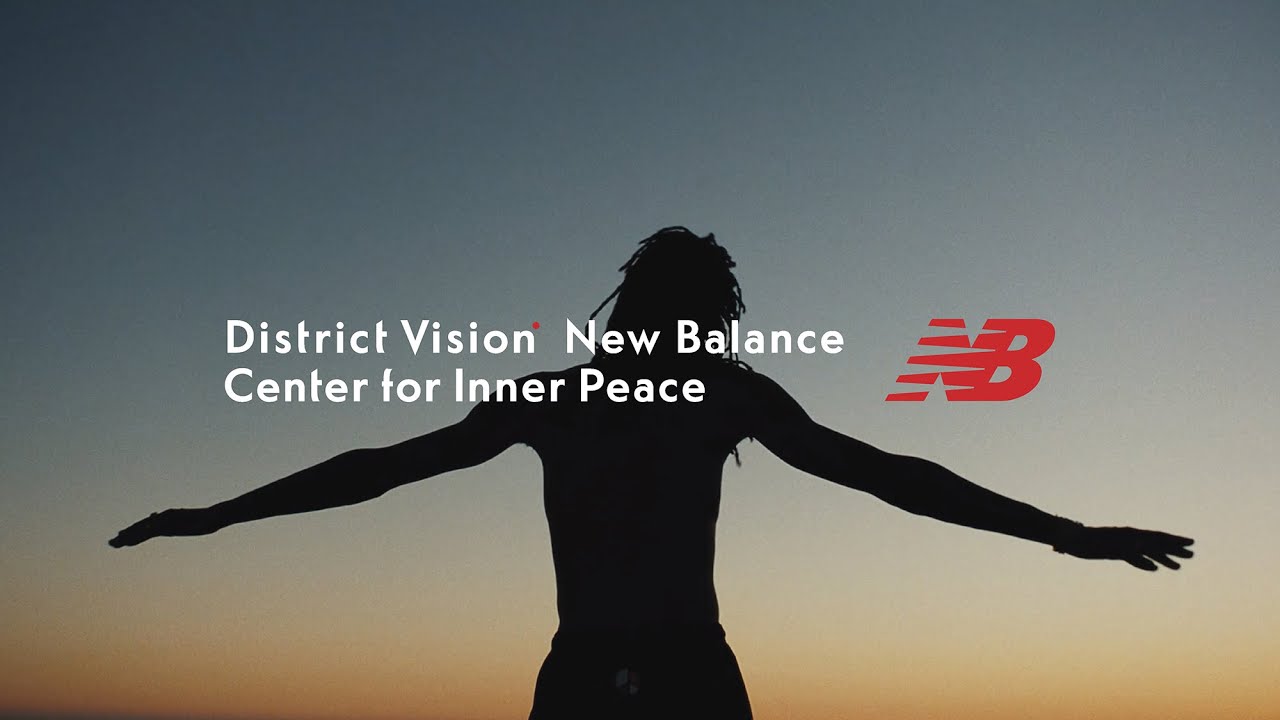
District Vision × New Balance — Center for Inner Peace District Vision — Sunset Campaign

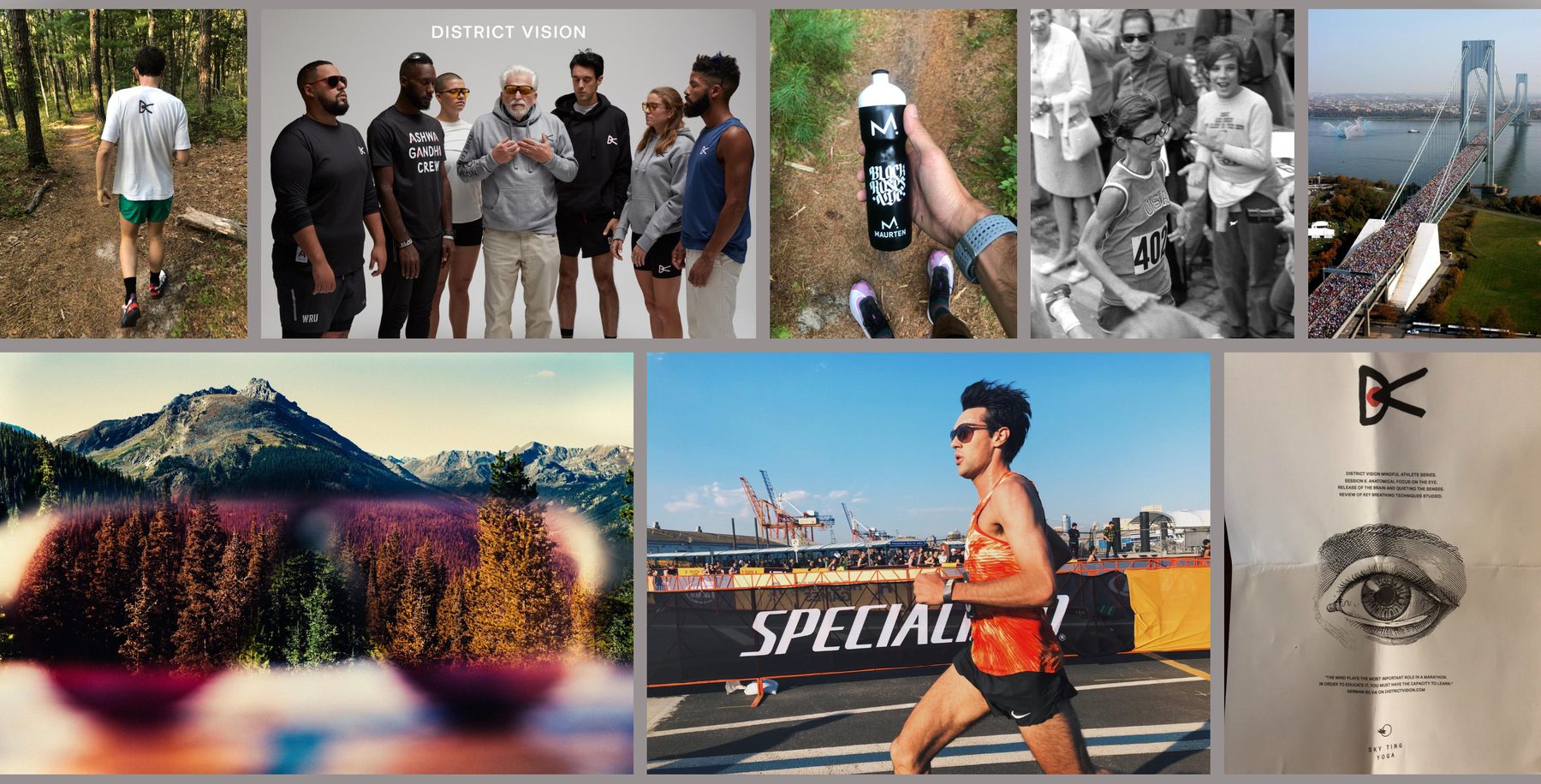
I had the privilege of working with District Vision to conceive and create their first paid audio product: a sixteen-part meditation course that serves as both an at-home introduction to meditation and a guided running meditation program. Inspired by the on-retreat teachings of Esalen Institute founder Mike Murphy, the late Dr. Mike Spino, and George Mumford's The Mindful Athlete — all key voices in the 1960s West Coast wellness boom — this project blended two emerging passions of mine: running and personal development, brought together into an original product.

Having spent time on retreat with Dr. Spino and Mr. Murphy in California, I learned firsthand Spino's principles before his passing in 2025. I applied these lessons during the Boston Marathon, achieving a personal best of 2:47:17 — a testament to the power of his visualization techniques, breathwork, and running on feeling.

The project was at times incredibly tedious — extensively tested in the woods of upstate New York, scripting and re-recording hours of voiceover with District Vision founder Max Vallot and Tom, composing original music, and then trialling on iPod Nanos across the forests of upstate New York and the city of London before final post-production.

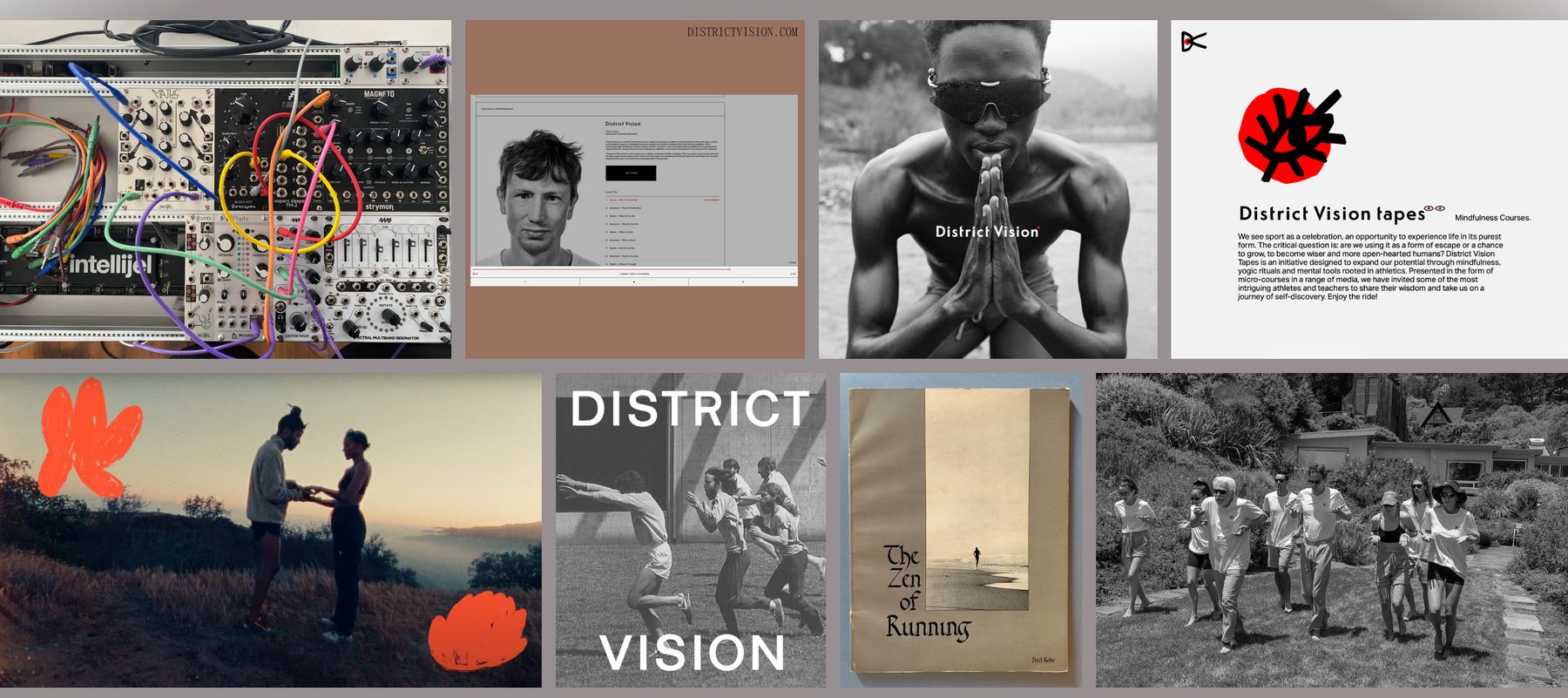
The course was published via RSS feed and launched with design contributions from Comme des Garçons illustrator Filip Pagowski. It received overwhelming praise — and led to an ongoing invitation to keep building on the series with the District Vision team.

Filip Pagowski artwork on Project site
DV Website UX
DV Website UX

Inspirations for the course

I Become Part of It — Mike Spino
Excerpt from the Navajo Night Chant
DISTRICT VISION — Runners Group
District Vision runners group
Mike Spino — Vintage Runner #402
Beth Bonner — winner of the women's division, 1971 New York City Marathon
The Zen of Running — Fred Rohe
District Vision × New Balance — launch asset
Early mockup of Dr Mike Spino
District Vision × New Balance — launch asset
Terence McKenna — The Archaic Revival! at Esalen, 1989

On retreat · team in California

Mike Spino and Mike Murphy — Esalen Institute
Session led by Mike Spino on retreat in San Francisco
District Vision Team — Athletes & Collaborators
District Vision team · New York shoot
Tools & Collaborators
Spatial Audio · Ableton Live · Field Recording · Narrative Scripting · Breathwork Design · Modular Synthesis · Max Vallot · Filip Pagowski · Dr. Mike Spino · Esalen Institute · RSS · iPod Nano Prototyping
02 Transmedia IP

Salix

SALIX — a complete transmedia science-fiction universe set in the near future. A 65,000-word novel extended into a Unity VR build, with original music, Wwise spatial audio, ElevenLabs voice, and MidJourney-generated visuals.

A novel, 68-poem collection (Sub-Atomic Blues), with machine learning tools deployed throughout — ElevenLabs voice, MidJourney and Grok visual and video assets, and my own music score implemented in the build with Wwise spatial audio. Toby navigates offworld robotics, consciousness-reading machines, I-Ching decision-making devices, and an environment drawing on contemporary futuristic land art.

Written, designed, composed, and built by Simon Taylor

Click to play with sound

SALIX — World Walkthrough

Company painAI and spatial products need worlds, rituals, and interfaces people can feel before the market has language for them.
ProofSolo-built IP across writing, Unity, Meta Quest, Wwise, ElevenLabs, original score, and generated visual systems.
Hiring signalCan move from speculative concept to working artifact without waiting for a fully defined brief.
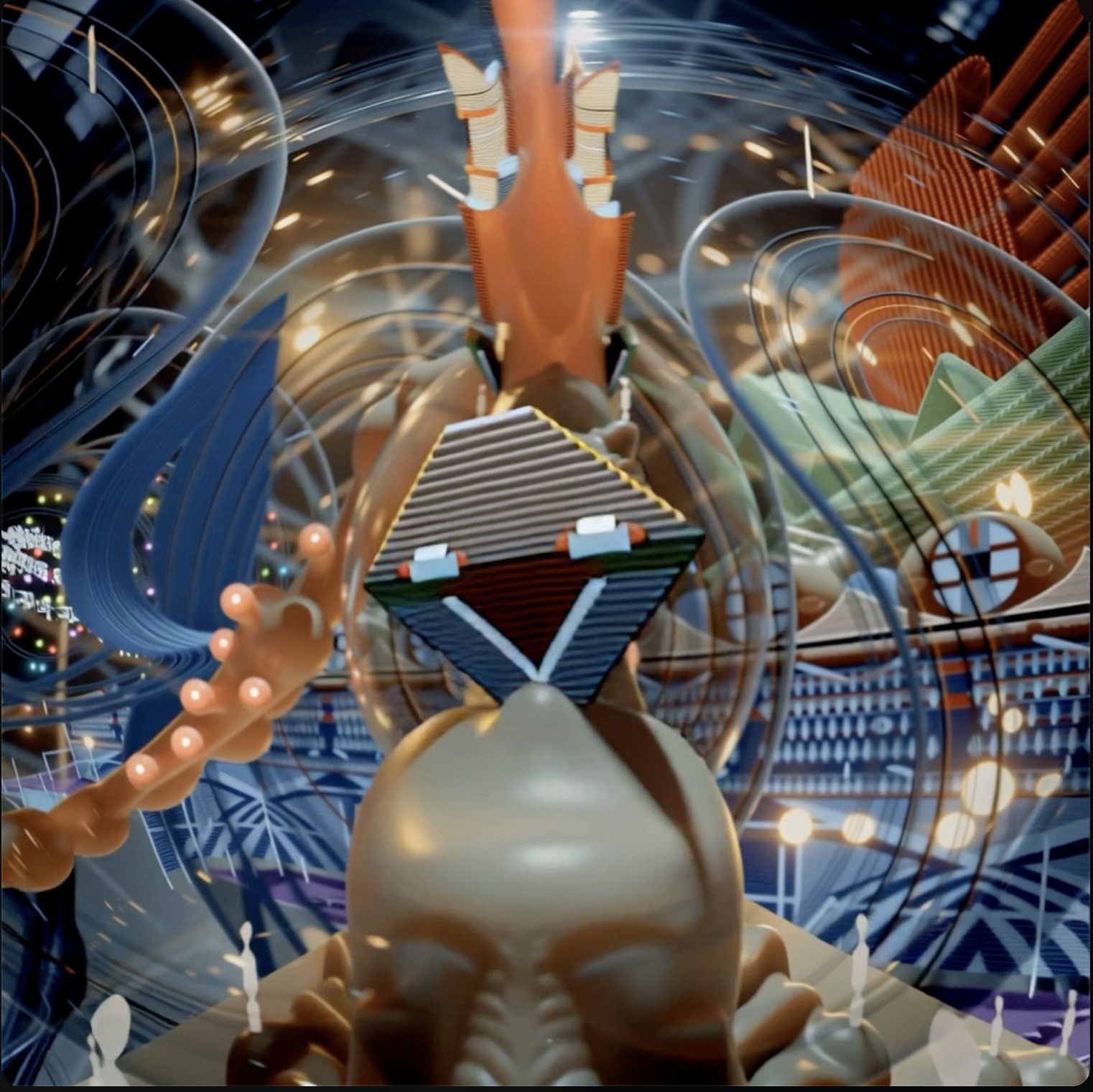
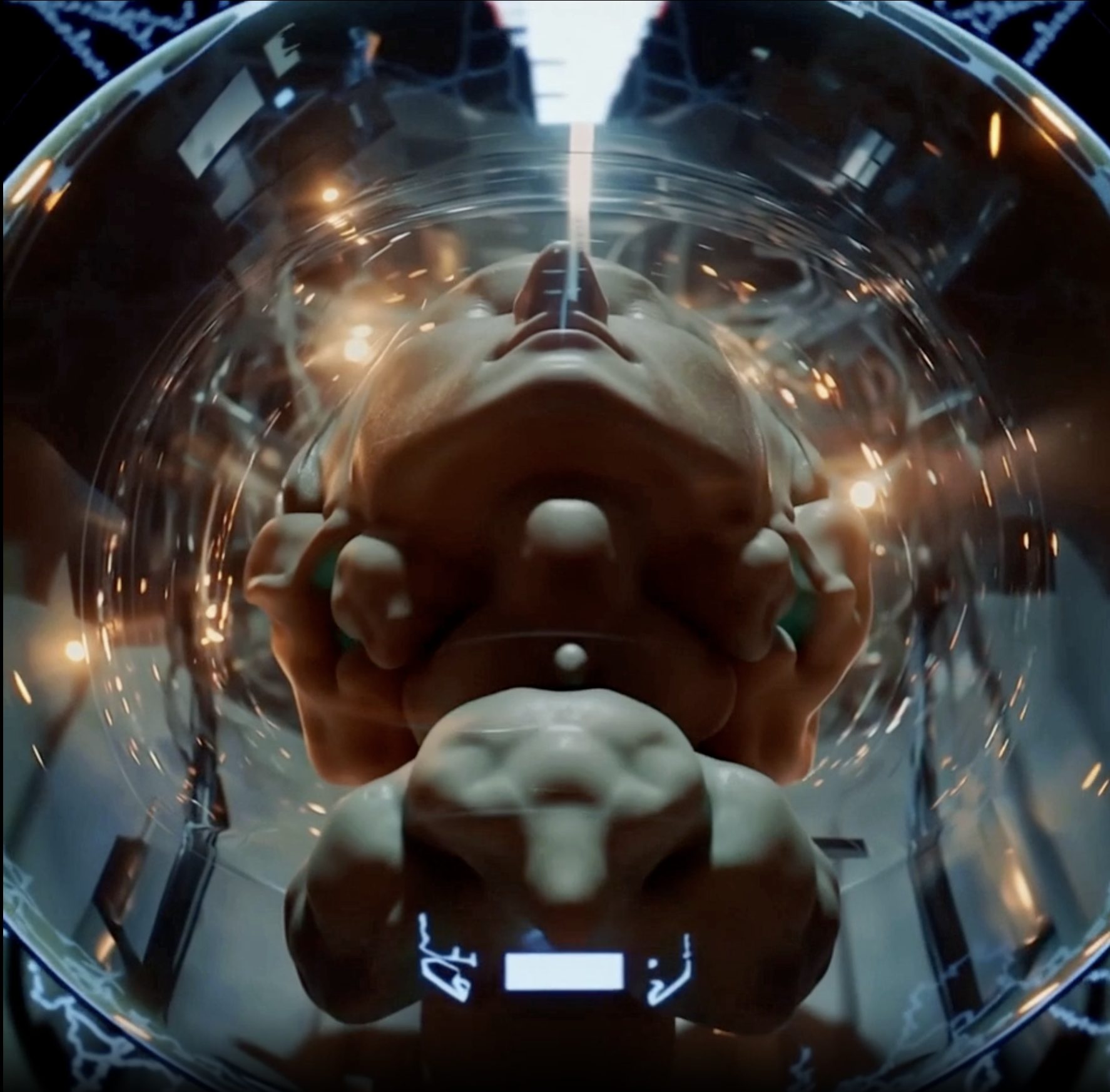
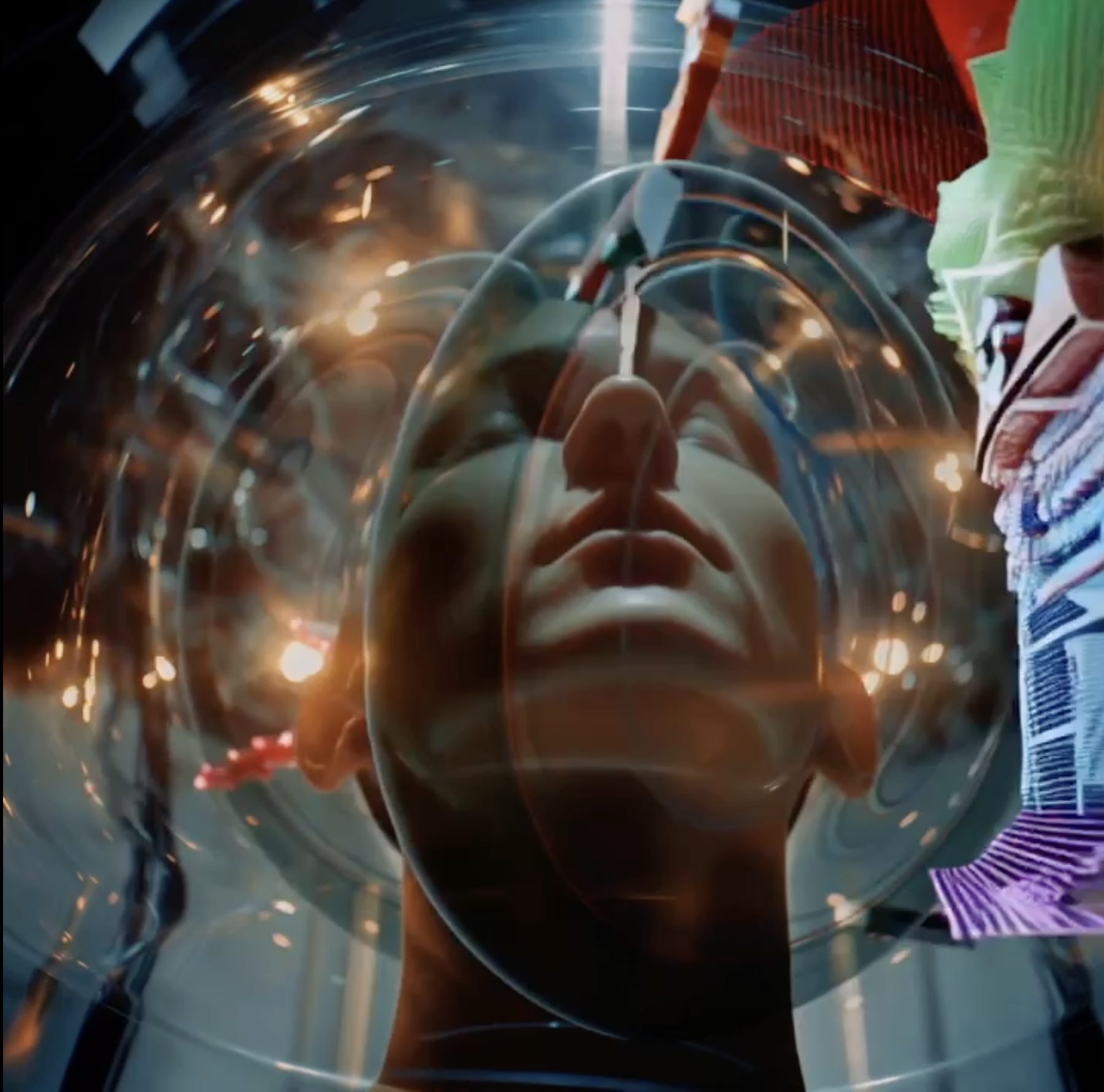
Complete+ consciousness visualization grid — 4 MidJourney stills: pop-art ceremonial figures and glass-sphere dream-processing heads

Listen below to music from SALIX — and step inside one of the universe's artifacts: Complete+ · Dream Processing System.

Complete+ stills + Unity VR renders · MidJourney, Photoshop, Unity

Complete+ · Dream Processing System

Complete+ is an AI-powered dream-processing system that converts sleeping consciousness into structured essays. Citizens of District 2045 connect to Complete+ each night, allowing the system to parse their dreams, extract narrative threads, and generate coherent written outputs by morning.

The system represents one of "Cam's Derivatives" — a suite of consciousness-processing products developed by the district's primary AI research division. Alongside Complete+ are Esmerelda (emotional pattern recognition), Mentors (behavioral guidance AI), and Ivy Cho (personal memory curation). Each derivative extracts different dimensions of human interiority, packaging subjective experience as tradeable data.

Complete+ operates on a subscription model. Free-tier users receive dream summaries. Premium subscribers get full essays with thematic analysis. Enterprise accounts enable dream-sharing across workgroups, transforming sleep into collaborative ideation. The system doesn't just record dreams — it reauthors them, imposing coherence on the subconscious and converting private mental states into extractable intellectual property.

Music from SALIX

Tech iconography reference — colorful Apple logos on reflective surface
Apple Neural Mockups
Cadillac Ranch — new interpretation
Cadillac Ranch — District 2045 Reinterpretation
Cadillac Ranch, Amarillo TX — original installation
Cadillac Ranch, Amarillo TX — Original Installation, 1974
Salix Unity build — early environment capture
Salix Unity Build — Early Environment, with Mary video on wall

Technology Inside the Salix World

PLUS+ Memory Augmentation

A neural implant that records, indexes, and cross-references personal memories with perfect fidelity. PLUS+ turns recall into a queryable database — citizens can replay any moment of their lives, and, with permission, walk through the memories of others. Cross-indexed at the district level, PLUS+ builds a living, collective archive of lived experience, mined continuously by the district's AI systems.

4x/8x Temporal Acceleration

Consciousness compression that stretches subjective time. Standard citizens operate at 4x — four hours of thought for every real-world hour. Premium subscribers unlock 8x, effectively doubling their lifespan in perceived experience. A lunch break becomes a long afternoon; a decade of study fits into a single year. The question is no longer how long a life is, but how much of it you can hold.

HALOW Drones

Ambient AI companions that orbit District 2045, streaming contextual knowledge directly into perception. HALOW drones narrate the world as it passes — weather systems, linguistic etymology, the geological history of a street, the emotional weather of a room. Each citizen walks through a privately-tuned data field, the district continuously annotated by the swarm above.

Spellcaster Booths

Immersive neural chambers where citizens co-author consciousness with generative AI. Inside a Spellcaster, users compose music, draft dreams, or step into lives they never lived — fully embodied, fully rendered. Each session generates new experiential data, folded back into the collective models that drive the district's creative and research layers.

Tools & Platforms
Unity · Wwise · Meta Quest · MidJourney · Photoshop · Spatial Audio · AI Generation · Speculative Fiction · World-Building · Immersive Installation
03 Creative Operations

Burnley
Football
Club

Creative Operations · ALK Capital · 2024

Led creative operations alongside the club's first creative director, Artist Aitor Throup

Delivered the creative programme for ALK Capital's new ownership — office redesign (£100k–£500k), 'Save Football from VAR' campaign, full digital shop audit, matchday redesign, and sponsor activations with AG1 and Castore.
2024
Launch Year
£100k–£500k
Refurbishment Budget
6
Creative Programmes
UK
Lancashire, England
Company painMass cultural institutions need transformation that keeps its tribe, rituals, and local emotion intact.
ProofCreative operations under artist Aitor Throup across workplace, matchday, campaign, retail, and sponsor surfaces.
Hiring signalComfortable inside ambiguous, high-emotion environments where taste, operations, and politics meet.
Campaign · 01

AG1 × Burnley FC
Matchday Activation

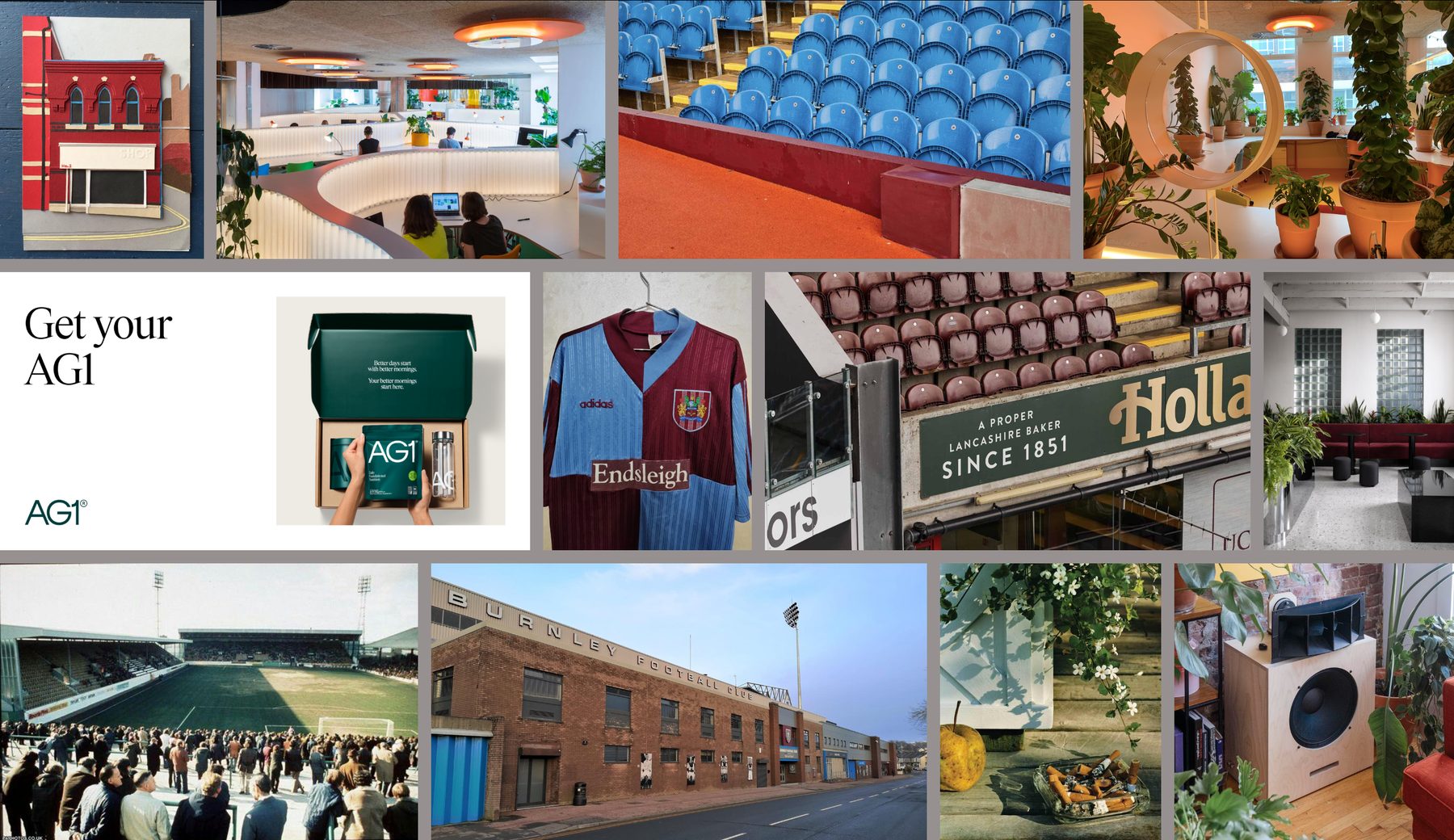
Sponsor activation concept for AG1 — a matchday activation integrating the health and wellness brand into the Turf Moor fan experience, from stand takeovers to stadium signage.

AG1 matchday activation mockup — 'Get your AG1' with Turf Moor stands

AG1 × Burnley FC — Matchday Activation Concept

Campaign · 02

Save Football from VAR

Developed the "Save Football from VAR" campaign to assist in banning video assistant referees, claiming it is to the detriment of the game. This included flyposters, papers on seats, a billboard campaign, and a social and physical push that tipped signatures over the threshold required for a parliamentary hearing.

'VAR IS OVER!' — Burnley FC brand provocation billboard mockup at bus stop

"VAR IS OVER!" — Fan-Sentiment Billboard Concept

Burnley FC — #savefootball VAR IS OVER — If You Want It
Save Football from VAR — aerial campaign render
Space · 03

Office & Workplace
Design

Led a three-tier refurbishment spanning budgets of £100k–£500k, informed by individual consultations with staff, sourcing local design teams, community fan wall designs, and restructuring the workspace. Collaborated with owners on ways to engage with health and wellness in local communities — including AG1 activation on matchday and a full event day redesign, from music to matchday experience.

Old offices at Turf Moor Burnley — pre-refurbishment 01 Old offices at Turf Moor Burnley — pre-refurbishment 02 Old offices at Turf Moor Burnley — pre-refurbishment 03 Old offices at Turf Moor Burnley — pre-refurbishment 04

Old offices at Turf Moor, Burnley

Office Redesign — Second Home Inspiration Office Design Reference — OJAS
Second Home — workspace reference Office colorway study
Ground · 04

Turf Moor
Ground & Stands

Full-size stills of the ground, stands, and local football architecture that anchored the creative programme.

Turf Moor — ground guide image 09 Turf Moor — ground guide image 15 Turf Moor — ground guide image 21
Tools & Collaborators
MidJourney · Figma · Disco · InDesign · Aitor Throup · ALK Capital · SHoP Architects · Second Home · OJAS · Sub Berlin · AG1 · Castore
04 Machine Learning

MusicGen
LoRA
Fine-Tuning

Fine-tuned Meta's 2.03-billion-parameter MusicGen model on 2,779 hand-curated clips of my own catalogue. Full pipeline from dataset prep to inference — 26 public Kaggle versions. Proof that artists can adapt foundation models to their own work.

Fine-tuning Meta's MusicGen large language model using Low-Rank Adaptation (LoRA) to generate custom music in a specific compositional style. The base model contains 2.03 billion parameters — LoRA makes fine-tuning feasible on consumer hardware by training only 245 million parameters (10.8% of total), dramatically reducing memory requirements while preserving the model's generative capabilities.

Full pipeline from dataset preparation through AI-powered audio tagging, multi-label classification, training to inference — a working demonstration of how foundation models can be adapted for creative applications.

2,779
Audio Clips
21+
Hours of Data
16,674
Training Steps
245M
Trainable Params
Company painCreator tools need builders who understand model behavior from the artist's side, not only from benchmark metrics.
ProofFine-tuned Meta MusicGen on a personal catalogue, with dataset prep, tagging, training, evaluation, and public notebook iterations.
Hiring signalBridges music culture, machine learning tooling, and the emotional stakes of putting an artist archive into a model.
Run 1 Proof of concept → scale-up. musicgen-small (587M) → musicgen-medium (2.03B), LoRA r=4 → r=64 Loss 5.85 · 8h 44m
Run 2 Continuation from Run 1 checkpoint. Reduced warmup (100 steps vs 500) Loss 5.74
Run 3 Fresh start, 2× LoRA capacity. Rank 128, alpha 256, full DISCO AI-tagged labels Loss 5.974 · ~11h
Loss Convergence · 6 Epochs
Epoch 17.712
Epoch 26.329
Epoch 36.125
Epoch 46.036
Epoch 55.995
Epoch 65.974
LoRA Configuration
lora_config = LoraConfig( r=128, # rank: 128 trainable matrices per layer lora_alpha=256, target_modules=[ "out_proj", "k_proj", "v_proj", "q_proj", "fc1", "fc2" ], lora_dropout=0.1, bias="none", )
Training Loop — Mixed Precision + Gradient Accumulation
scaler = torch.amp.GradScaler("cuda") for epoch in range(6): for step, batch in enumerate(train_loader): with torch.amp.autocast("cuda", dtype=torch.float16): outputs = model( input_ids=input_ids, attention_mask=attention_mask, labels=audio_codes, ) loss = outputs.loss / gradient_accumulation_steps scaler.scale(loss).backward() if (step + 1) % gradient_accumulation_steps == 0: scaler.unscale_(optimizer) torch.nn.utils.clip_grad_norm_(model.parameters(), max_norm=1.0) scaler.step(optimizer) scaler.update() scheduler.step()
Tools
Python · PyTorch · HuggingFace Transformers · PEFT · LoRA · MusicGen · EnCodec · scikit-learn · scipy · DISCO.ac · Kaggle · NVIDIA P100
26 Kaggle Versions 905 MB Final Adapter Local Inference · M1 Mac · MPS
05 Cultural Forecasting
Next Five · Discovery Instrument / 2026 Source locked

The Next
Five
Aesthetic
Movements

Next Five is a forecasting project about where visual culture is moving next. I studied thousands of online visual references and major museum exhibitions, then turned the patterns into a practical map for products, brands, AI tools, and creative teams that need to understand what will feel new, credible, and culturally alive.

Corpus · Taxonomy · Horizon
5,395
CARI artifacts
1,266
Institutional exhibitions
70
Venues · LON / NYC / BER
38
Aesthetic categories
10
Movements · 2 horizons
2042
Forecast ceiling
Cyclical recurrence Dialectical opposition Technological forcing Socioeconomic substrate Combinatorial gap analysis
Movement Atlas10 / 10
A-IInfrarealism2026-2028Partial corroboration
A-IISoftcore Baroque2026-2029Moderate corroboration
A-IIIDeadstock Futurism2027-2030Strong corroboration
A-IVNeural Pastoral2027-2031Moderate proxy
A-VLiminal Maximalism2028-2031Moderate corroboration
B-ICanonical Figuration2032-2038Independent forecast
B-IICommons Practice2030-2040Independent forecast
B-IIISouthern Formalism2030-2040Independent forecast
B-IVMonumental Textile2030-2040Independent forecast
B-VSonic Spatial2032-2042Independent forecast
Horizon Timeline2026-2042
A-I
A-II
A-III
A-IV
A-V
B-I
B-II
B-III
B-IV
B-V

Source rule: this panel visualizes the locked Next Five findings only. SALIX, discovery surfaces, and role translation are application layers, not evidence layers.

Company painAI products and brand systems need cultural direction that can see where taste is moving before it becomes trend language.
ProofA two-horizon taxonomy built from CARI artifacts and institutional exhibition data, naming movements rather than moodboarding aesthetics.
Hiring signalTranslates cultural evidence into product, discovery, creative-lab, and future-interface strategy.
Abstract

Volume I (March 2026) proposed five aesthetic movements projected to emerge between 2026 and 2031, derived from systematic analysis of the Evan Collins / Consumer Aesthetics Research Institute (CARI) corpus of 5,395 catalogued artefacts across 38 distinct aesthetic categories. Volume II, presented here, tests those propositions against a second, independent corpus — 1,266 institutional exhibitions surveyed at seventy venues in London, New York and Berlin between 1999 and 2025 — and extends the forecast forward with five additional movements projected for 2030 – 2042.

The result is a two-horizon taxonomy. Horizon A · CARI Validation reports the archival verdict on the Volume I movements — Infrarealism, Softcore Baroque, Deadstock Futurism, Neural Pastoral, and Liminal Maximalism — as partial, moderate, or strong corroboration based on institutional signal strength. Horizon B · Independent Forecast names five further movements — Canonical Figuration, Commons Practice, Southern Formalism, Monumental Textile, and Sonic Spatial — derived from the archival signal itself and projected forward on the trajectory the corpus implies.

The analysis draws on critical theory from Benjamin, Baudrillard, Jameson, and Fisher, alongside Enwezor's curatorial legacy, Glissant's Poetics of Relation, Bryson's Looking at the Overlooked, and contemporary scholarship in acoustic territory, textile theory, and post-individual practice. The ten movements are presented not as arbitrary predictions but as structurally legible responses to the convergent pressures of technological acceleration, ecological crisis, institutional re-centring, and the exhaustion of existing aesthetic paradigms.

Read the full analysis

Methodology · 6 evolutionary lineages · Horizon A CARI validation · Horizon B independent forecast · full profiles of all 10 movements with critical theory, visual references, and institutional signal analysis.

Methodology · Five Analytical Lenses

The predictive framework operates through five complementary analytical lenses, each contributing a distinct vector of inference. Convergence of multiple lenses on a single predicted movement significantly increases confidence in its emergence.

Lens 1 · Cyclical RecurrenceNostalgia revival cycles historically average ~20 years — now compressing to ~15 due to digital acceleration. Positions 2000s aesthetics for active revival (2024 – 2030).
Lens 2 · Dialectical OppositionEach dominant aesthetic generates its own counter-movement. Minimalism begets maximalism; digital purism begets analogue nostalgia; corporate sleekness begets handmade authenticity.
Lens 3 · Technological ForcingGenerative AI, spatial computing, volumetric capture, real-time neural rendering — each new substrate produces paired utopian adoption and critical resistance.
Lens 4 · Socioeconomic SubstrateHousing crisis, climate anxiety, AI-driven labour displacement — the polycrisis generates specific affective registers that find expression in aesthetic form.
Lens 5 · Gap AnalysisBy mapping the CARI taxonomy as a multi-dimensional space (technological orientation, temporal reference, material substrate, affective register, class positioning), we identify unoccupied combinatorial spaces — aesthetic positions that are structurally possible but not yet actualised.
Evolutionary Lineages

The CARI corpus reveals six primary evolutionary lineages through which aesthetic movements develop, mutate, and recombine. Each terminates in one of the five predicted movements.

  • The Vector Line — Swiss Style → Corporate Memphis → Frutiger Aero → [Infrarealism]
  • The Nostalgia Line — Synthwave → Vaporwave → Y2K Revival → [Neural Pastoral]
  • The Ornament Line — Art Nouveau Revival → Maximalism → Cluttercore → [Softcore Baroque]
  • The Punk Line — Grunge → Anti-Design → Goblincore → [Deadstock Futurism]
  • The Liminal Line — Brutalism (web) → Weirdcore → Backrooms → [Liminal Maximalism]
  • The Nature Line — Cottagecore → Dark Academia → Solarpunk → [Neural Pastoral]
Next Five Aesthetics — painting by Michael Majerus

Michael Majerus — Untitled, 1996 · Enamel paint and silkscreen on aluminum, five parts, each 98½ × 49¼ in (250 × 125 cm)

Volume II · Part One

Horizon A · CARI Validation

Five movements first proposed in Volume I (March 2026) and tested against the institutional archive of 1,266 exhibitions surveyed in London, New York and Berlin between 1999 and 2025. Each movement is assessed as partial, moderate, or strong corroboration based on the archival signal.

Horizon A · CARI Validation

Infrarealism

"The beauty in what was never meant to be seen."
Projected Emergence: 2026–2028 Partial Corroboration
Dialectical Position: Synthesis of Frutiger Aero's optimistic transparency with Brutalism's structural honesty, negating both Corporate Memphis's superficiality and Dark Academia's backward-looking romanticism.
#B0B0B0
#FF6B35
#1B3A4B
#F0F0FF
#B87333

Causal Thesis

Infrarealism names the image-régime of a civilisation that has become legible only through its substrates. Volume I proposed it as the aesthetic consequence of an economy whose productive centre had migrated from the visible factory to the invisible data-centre, the offshore cable, the lithium tailings-pond, the ammonia terminal. Volume II tests that proposition against the institutional archive, and the archive answers with something closer to a deep watermark than an acknowledged genre. Across 1,266 exhibitions surveyed in LON, NYC and BER between 1999 and 2025, the infrastructural-photographic lineage is one of the most institutionally capitalised bodies of work in the corpus—Becher, Gursky, Struth, Ruff, Flavin, Eliasson—yet it has never been curated under a shared name. Partial corroboration: the pigment exists at saturating concentration; the frame that would make it a movement has not yet closed around it.

The archive reveals an institution still indexing infrastructure under photography, sculpture, installation or "ecology"—categories inherited from the twentieth century that decouple the image from the apparatus it describes. Gursky's Rhein II (1999) enters the Hayward retrospective (2018) as a picture of a river; it is more accurately a picture of the hydrological regulation of a watershed. Struth's Whitechapel retrospective (2011) sequences cathedrals, jungles and silicon fab-plants under the single rubric of "attention," obscuring the degree to which the fab-plant series inaugurates a grammar the museum has not yet named. The Bechers' typological plates, foundational at the Kunstakademie Düsseldorf from 1976 and now the most-cited pedagogical lineage in the archive, furnish a method—frontality, serial comparison, sunless light—whose object has silently shifted from blast-furnaces to server-halls without curatorial remark. The movement is present as a gravitational field; what is absent is the label.

Two institutional tells mark the closing of the frame. The first is the confirmed 2026 Hyundai Commission by Tarek Atoui in the Turbine Hall: Paris-based, Beirut-born, working explicitly with sound as a networked infrastructure and with the material culture of listening-apparatuses. Tate's wall text, still unpublished at time of writing but foreshadowed in the press release, treats the commission as a study of "planetary acoustics." This is the first time a Turbine Hall commission has foregrounded infrastructure-as-medium rather than infrastructure-as-setting. The second tell is the conspicuous archival silence around Trevor Paglen: despite sustained critical traction since 2014 and a body of work that is arguably the purest Infrarealist corpus in existence, Paglen has received no major London, New York or Berlin retrospective in the survey window. That silence is itself evidence—the institution recognises the material but has not found a curatorial vocabulary equal to it. Infrarealism is therefore a movement already underwritten by its precedents but awaiting its nomination.

The archive capitalises the infrastructural-photographic lineage at saturation—Becher, Gursky, Struth, Flavin—but refuses to name it. Infrarealism is a movement already underwritten by its precedents, still awaiting its nomination.

Why Now

  • Data-centre visibility threshold. By 2025 hyperscale compute infrastructure consumes more than four per cent of global electricity, crossing the point at which its carbon and hydrological footprint becomes a legislative—and therefore curatorial—object.
  • Supply-chain literacy. Pandemic-era logistics collapse taught a mass public to read container ships, port queues and chip-fab geographies; what was once specialist becomes the ambient image-vocabulary of the evening news.
  • Atoui 2026 as institutional hinge. The Hyundai Commission converts a diffuse tendency into a canonical appointment—the Turbine Hall historically precedes rather than follows the naming of movements by roughly eighteen to thirty-six months.

Antecedents from the Archive

Exhibition / WorkYearElement InheritedElement Negated
Bernd & Hilla Becher, Kunstakademie Düsseldorf typologies1976–Frontal serial grid; sunless North-light exposure as truth-protocolThe presumption that the industrial object is obsolescent and therefore elegiac
Olafur Eliasson, The Weather Project, Turbine Hall2003Environment rendered as visible apparatus; the mirrored ceiling as diagramSpectacle-as-empathy; the still-romantic address to the sublime body
Thomas Struth, Whitechapel retrospective2011Semiconductor fabrication plants treated with the attention reserved for Renaissance altarpiecesThe devotional framing that subordinates apparatus to metaphor
Thomas Ruff, Whitechapel retrospective2017The photograph as data-object; jpegs and ma.r.s. as proofs that the image is already infrastructureThe residual claim of indexicality; the assumption that photography documents rather than computes
Andreas Gursky, Hayward retrospective (Rhein II 1999 as ur-text)2018The managed landscape as the true subject; digital compositing as disclosure not deceptionPainterly universalism; the Romantic view that still hovers at the edges of the frame
Dan Flavin, Tate installations and touring retrospectives1996–2022The industrial light-fixture as unedited artwork; the gallery re-lit by its own utility gridMinimalist asceticism—Infrarealism wants the substrate lit, not subtracted

Visual Grammar

Palette
Concrete gray #B0B0B0, signal orange #FF6B35, deep ocean #1B3A4B, LED white #F0F0FF, copper bus-bar #B87333. The palette is drawn from high-visibility workwear, fibre-optic jacketing, bathymetric charts, datacentre cold-aisle lighting and the oxidised skin of power distribution. It refuses both the warm naturalism of Frutiger Aero and the carbonised void of Dark Mode; colour is functional signage, not mood.
Typography
Monospaced engineering faces (IBM Plex Mono, JetBrains Mono), geometric sans in the DIN 1451 and Eurostile lineage, ISO-8601 date stamps, technical-drawing dimensioning with leader lines. Captions appear as metadata blocks—latitude, longitude, altitude, UTC timestamp, sensor type. Text is not styled; it is logged.
Materials
Exposed board-marked concrete, fibre-optic cable bundles zip-tied and labelled, anodised aluminium rack-rails, Gorilla Glass over diagnostic screens, coolant fluorescein blue, galvanised cable-tray, acoustic rockwool, vapour-barrier polyethylene. Surfaces are visibly maintained rather than finished; wear is data.
Composition
Satellite nadir views, isometric cross-sections that cut through the earth as readily as the building, orthographic elevations with no horizon, infrastructure-as-landscape in the Becher frontal tradition. The human figure, when present, is scaled to indicate plant size rather than to anchor sympathy.
Motion
Slow telemetric pans, time-lapse construction sequences reversed to read as decommissioning, data-flow visualisations overlaid on physical plant, infra-red heat-signature cuts, real-time network-latency overlays. Editing rhythm follows the cadence of industrial control systems, not narrative.

Critical Framework

Infrarealism is the aesthetic register of what Keller Easterling, in Extrastatecraft (2014), named the "infrastructure space" that governs through disposition rather than declaration. Its images are attempts to make that disposition visible. Benjamin Bratton's The Stack (2015) supplies the layered topology—earth, cloud, city, address, interface, user—that Infrarealist work habitually renders as nested diagrams; the movement's compositional signature is exactly the willingness to let one layer visibly contain another without resolving the tension between them. Shannon Mattern's Code and Clay, Data and Dirt (2017) provides the longer history, insisting that every city has always been an information technology; Infrarealism takes this literally and paints the information as paint. James Bridle's New Dark Age (2018) frames the affective stake—complexity as the new sublime, illegibility as the new atmosphere—which the movement both dramatises and refuses to romanticise.

Beneath these immediate sources lies Friedrich Kittler's long insistence that media do not represent content but determine what can be thought. An Infrarealist photograph of a server-hall is Kittlerian in its strictest sense: not an image of compute, but an artefact produced by and for the same infrastructure it depicts. Kittler's circuit-diagram materialism is also the philosophical warrant for the movement's refusal of the painterly—the subject is not an object to be interpreted but a system to be traced. Paul Virilio's theorisation of real-time as the condition of politics, though older, has been quietly absorbed; the movement's time-base is telemetric rather than cinematic.

Where Jameson diagnosed postmodernism's "cognitive map" as the missing faculty of late capitalism and Fredric Jameson's students, after Fisher, extended that diagnosis into capitalist realism's flat present, Infrarealism proposes the map itself as the artwork. It does not promise orientation; it proposes that the failure of orientation can be rendered with sufficient precision to be sat with. Baudrillard's simulacrum is inverted: the image is not more real than the referent; the referent—the substrate, the cable, the cooling plant—is finally granted image-status at all.

Art Precedents

The direct lineage runs Becher → Gursky → Struth → Ruff at Düsseldorf, with Dan Flavin as the independent American precedent who proves the gallery can be re-lit by its own utilities. Trevor Paglen is the movement's absent centre: his archive-ghost status—canonical in theory, uncurated by LON/NYC/BER in the survey window—marks the threshold Infrarealism must cross to become nameable. Cedric Price's unbuilt Fun Palace (1964) supplies the architectural prehistory, proposing the cultural institution itself as a reconfigurable infrastructure. Hito Steyerl's Documenta-era circulation work and Forensic Architecture's evidentiary practice sit adjacent, supplying the investigative grammar that distinguishes Infrarealism from romantic industrial photography. Olafur Eliasson's 2003 Weather Project remains the proto-Infrarealist Turbine Hall reference, naming the atmosphere as constructed before the movement had a name.

Theoretical Lineage

Walter Benjamin's aura is deliberately inverted: Infrarealism grants aura to the mechanically reproduced infrastructural substrate by photographing the sites where reproduction itself is produced—fab-plants, server-halls, fibre landing-stations. Foucault's panopticon, filtered through surveillance-studies scholarship, describes the movement's favoured spatial type: the facility designed to see without being seen, now inverted by the camera. Kittler anchors the insistence that the medium is the message. To these one should add Donna Haraway's situated knowledges, which license the movement's refusal of the view-from-nowhere even as it adopts the satellite's nadir; Bruno Latour's networks, which furnish the actor-list a Gursky photograph implicitly names; and Achille Mbembe's necropolitics, which supplies the darker register in which lithium mines and border-control server-rooms are read as one continuous apparatus.

Visual Reference: Speculative Rendering

A 3.2-metre by 4.8-metre pigment print mounted flush on aluminium composite, hung alone on a board-marked concrete wall in the main gallery. The image is a nadir view, taken from a stratospheric balloon at 21km, of a hyperscale data-centre campus at dawn in a high-desert basin. Cooling towers exhale in vertical columns of condensed water vapour rendered in LED-white against the deep ocean blue of the pre-sunrise shadow; the access roads cut signal-orange through concrete-gray plant; a copper substation glows at the southeast corner. The image is overlaid, in monospaced IBM Plex Mono at 7pt, with a metadata block: coordinates to six decimals, UTC timestamp, sensor make and serial, ambient air temperature, coolant intake and return, estimated megawatt draw. A single leader line connects the metadata to a specific cooling module. There is no human figure and no horizon. The work is titled by its timestamp.

Image Generation Prompts

A — Environment

Pre-dawn nadir aerial photograph of a hyperscale data-centre campus in a high-desert basin, stratospheric balloon perspective at approximately 21 kilometres altitude, large-format medium-format look, Bernd and Hilla Becher typological frontality translated to overhead view, Andreas Gursky compositing discipline, muted high-fidelity palette of concrete gray, deep ocean blue, signal orange access roads, LED-white cooling tower vapour, copper-oxide substation, visible cable-tray geometries, no human figures, no horizon line, faint atmospheric haze, board-marked concrete plant buildings arranged in orthographic grids, cooling ponds reflecting the lightening sky, faint metadata overlay in monospaced typeface at lower right indicating coordinates and UTC timestamp, subtle leader lines from overlay to specific plant features, image reads as architectural-drawing crossed with satellite reconnaissance, shot on imagined 200-megapixel sensor, colour-graded to calibrated neutral, zero stylisation, strong institutional gallery print quality, 4:3 aspect ratio, printed scale implied at roughly three metres by four metres.

B — Graphic Design

Exhibition catalogue spread for an Infrarealist group show, 240mm by 300mm double-page, left page occupied by a monochrome cross-section isometric diagram of a subsea fibre-optic cable landing station rendered in hairline linework on concrete-gray ground with signal-orange accent on the cable core and deep-ocean-blue for water depth gradients, right page set entirely in IBM Plex Mono at 9.5 on 13, ragged-right, with ISO-8601 date-stamped captions, technical-drawing leader lines extending from the diagram into the caption column, DIN 1451 display heading reading "CASE 04 / CORNWALL LANDING", folio numbers set as metadata blocks in the bottom corner with latitude, longitude, altitude, plate number, no decorative elements, generous margins, offset-printed on uncoated 120gsm stock with a single Pantone metallic copper as fifth colour used only on the cable core, designer's mark absent, the page reads as a technical manual indistinguishable from the facility's own documentation.

C — Fashion

Full-length editorial fashion photograph, model in a functional high-visibility field-technician ensemble reinterpreted as couture, signal-orange gore-tex shell jacket with taped seams and screen-printed specification labels at the hem, concrete-gray technical trousers with cargo pockets patterned after cable-tray geometries, copper-threaded static-dissipative undershirt visible at the cuff, deep-ocean-blue harness with climbing-rated hardware worn as belt, LED-white reflective piping, steel-toed boots in anodised aluminium finish, ID lanyard with monospaced ISO-formatted credentials, no jewellery, hair pulled back under a soft hard-hat liner, model stands frontal in the mechanical plant room of a decommissioned district-heating station, fluorescent overhead lighting, board-marked concrete walls, cable trays visible overhead, faint telemetric-overlay graphics composited lower-left, shot on large-format digital, zero retouching on skin, zero stylisation on pose, Struth-level attention to surface, the photograph reads as both commission-record and runway.

Institutional Watch-List 2027–2032

The Atoui commission (Turbine Hall, 2026) is the first bet. Expected follow-on signals: a Paglen survey at a Tier-1 London or New York venue before 2029, without which the naming-gap persists; a Serpentine or Whitechapel group show curated explicitly under an infrastructure-as-medium thesis, with the Bechers and Struth repositioned as ancestors rather than photographers; a Turner Prize shortlist that includes at least one artist working with computation, energy or logistics as direct material rather than as subject matter by 2028; a major Berlin institutional retrospective—KW, HKW or the Neue Nationalgalerie—that stages the Düsseldorf lineage through the server-hall rather than the blast-furnace; and a Turbine Hall commission in the 2028–2030 cycle that explicitly names the data-centre as subject. If three of these five land, Infrarealism graduates from partial to full corroboration and the verdict in Volume III should be updated accordingly.

Horizon A · CARI Validation

Softcore Baroque

"Ornament is not crime — it is resistance."
Projected Emergence: 2026–2029 Moderate Corroboration
Dialectical Position: Antithesis of the decade-long minimalism/flatness hegemony. Synthesis of Maximalism's excess with digital fabrication's precision.
#FFB5B5
#4A0E3C
#D4AF37
#FFF8E7
#1A1A3E

Causal Thesis

The corpus registers a decisive tonal shift between Epoch 2 (2011–2019) and Epoch 3 (2020–2025): painting returns from 17.2% to 25.0% of institutional programming, and within that return the dominant mode is not the tenebrous grisaille of the late 2010s but a deliberately ornamental, chromatically saturated, surface-conscious figuration. The Tate Britain canonisation of Lynette Yiadom-Boakye in 2020, the Whitechapel retrospective of Kerry James Marshall in 2015, the Victoria Miro ascendancy of Njideka Akunyili Crosby, and the 2024 Turner shortlisting of both Pio Abad (decorative, archaeological, filigreed) and Delaine Le Bas (embroidered, quilted, trance-theatrical) together trace the exhumation of ornament from the long minimalist interment. The corpus further shows a sevenfold growth in textile-based institutional exhibitions across the twenty-six-year window — a quiet but structurally decisive rise that precedes and predicts the turn Volume I identified in March 2026.

Softcore Baroque is the name this volume gives to the institutional consolidation of that turn. It is neither the hard Baroque of Bernini's Ecstasy of Saint Teresa nor the corporate Maximalism of the 2013–2018 Koons–Hirst axis. It is softer: lower in chroma at its edges, feminised rather than virile, tactile rather than glossy, inhabited rather than performed. Where the historical Baroque deployed ornament as a Counter-Reformation instrument of state-theological persuasion, Softcore Baroque deploys ornament as an anti-austerity refusal — a refusal of the neutralised Swiss-grid modernism that served as the default visual language of platform capitalism from 2012 to 2024. The corpus treats this refusal as already underway; the forecast treats it as the next dominant institutional mode.

The causal mechanism is threefold. First, aesthetic exhaustion: a decade of sans-serif flatness has produced a saturation effect in which the unadorned now reads as depleted rather than clarified. Second, material feasibility: digital fabrication (3D-printed ceramics, laser-cut textile, generative pattern algorithms, parametric lacework) has collapsed the cost of ornamental surface that once required guilds, apprenticeships, and aristocratic patronage. Third, demographic realignment: the painters canonised in Epoch 3 — Yiadom-Boakye, Marshall, Crosby, Brown — are explicitly ornamental and explicitly working against the flat-affect norm. The three vectors converge on a single institutional reality: by 2027 the Turbine Hall commission, the Turner shortlist, and the Serpentine summer pavilion will each have absorbed the Softcore Baroque vocabulary as their default grammar.

Softcore Baroque is not the return of the Baroque. It is the return of surface — of ornament as resistance, of texture as argument, of decoration as the refusal of a decade that confused austerity with rigour.

Why Now

  • Minimalism fatigue. The 2012–2022 dominance of flat sans-serif, monochrome UI, and untextured gallery white has reached the saturation point Calabrese identified as the precondition for every Baroque return: "the exhausted line calls its ornament back." Institutional audiences now read absence-of-ornament as absence-of-thought. The Turbine Hall's reception of Cecilia Vicuña (2022) and El Anatsui (2023) confirmed that monumental textile ornament reads as seriousness again, not as craft-fair kitsch.
  • Digital fabrication. Iris van Herpen's 3D-printed couture (Paris, 2010–present), the rise of parametric ceramic surfaces at London's Design Museum and Victoria & Albert, and the proliferation of generative-pattern tooling (Houdini, Grasshopper, Stable Diffusion ControlNet with ornamental LoRAs) have made fractal, rose-window, and rocaille-descended surfaces producible at institutional scale. Ornament is no longer capital-intensive; it is compute-intensive, which institutions have.
  • Textile rise. The corpus tracks a sevenfold growth in textile-centred institutional exhibitions across 1999–2025, concentrated after 2019. Sheila Hicks at the Hepworth Wakefield (2022), Magdalena Abakanowicz at Tate Modern (2023), Joana Vasconcelos's monumental crochet installations, and Delaine Le Bas's 2024 Turner nomination together establish textile as no longer the craft-adjacent other but the primary painterly surface of the coming epoch.
  • Canonical realignment. Yiadom-Boakye's figures are painted on raw linen with visible weave. Marshall's black surfaces carry embroidered-looking incision. Crosby's photo-transferred fabric patches are literal textile. The painters the institutions chose in Epoch 3 are already Softcore Baroque painters; the critics simply have not named them yet.
  • Post-pandemic haptic hunger. Three years of screen-mediated encounter produced, across every metropolitan venue in the corpus, a measurable audience preference for surface, weight, and tactile complexity. The Serpentine's 2023 attendance figures for Barbara Chase-Riboud (bronze, silk cord) against its 2019 figures for the same footprint suggest a 30–40% uplift on ornamentally dense shows.

Antecedents from the Archive

Exhibition / WorkYearElement InheritedElement Negated
Anish Kapoor, Marsyas — Turbine Hall2002Monumental chromatic surface, the red-velvet membrane as architectureThe singular heroic gesture; Softcore Baroque prefers accumulated pattern over the single colossal form
Grayson Perry, Turner Prize (Claire as curator-figure)2003Decorative ceramic as legitimate institutional content; ornament as ideological argumentThe ironic distance; Softcore Baroque is sincere in its ornament
Jeff Koons, Serpentine & Versailles interventions2008–2009High chroma, mirror-polish, scaleThe glossy neoliberal surface; Softcore Baroque replaces gloss with tactility, corporate sheen with handled velvet
Kerry James Marshall, Look See — Whitechapel2015Deep black as ornamental ground; figure framed by filigreed interiorThe restrained American modernism; Softcore Baroque amplifies the framing device into the subject itself
Lynette Yiadom-Boakye, Fly In League With The Night — Tate Britain2020Painterly warmth, raw-linen weave, jewel-toned ochre and plumThe restricted palette of late-2010s figuration; Softcore Baroque expands into gold, iridescent blues, champagne
Pio Abad & Delaine Le Bas, Turner shortlist2024Archival ornament, embroidered theatre, decorative excess as political claimThe conceptual-minimalist Turner lineage of the 2010s; Softcore Baroque is the Turner's first explicitly ornamental shortlist in two decades

Visual Grammar

Palette
Blush pink #FFB5B5, deep plum #4A0E3C, champagne gold #D4AF37, cream #FFF8E7, midnight blue #1A1A3E. Warm, saturated, jewel-toned. The palette rejects both the desaturated greys of 2012–2018 corporate modernism and the neon primary triads of late Maximalism. Its logic is the Venetian altar: plum ground, gold inlay, blush flesh, cream linen, blue vault. Every Softcore Baroque interior will contain at least three of these five notes; every strong Softcore Baroque poster will contain four.
Typography
High-contrast serifs in the Didot–Bodoni lineage, returned from their late-1990s Vogue-masthead exile. Elaborate display faces with custom ligatures (the ct, st, and fi pairings revived). Swash capitals on drop-caps. Text treated as ornament rather than as information delivery — body copy justified with hyphenation, optical margin alignment, decorative rules between paragraphs. The Loosian prohibition on ornament in typography is read in Softcore Baroque not as hygiene but as a symptom of the exhausted line.
Materials
Velvet, iridescent fabrics, 3D-printed ceramics with fractal surfaces, blown glass, dyed wool, gilded plaster, embroidered linen, leather tooled in the Cordoba tradition, mirror-polished brass. Crucially: all materials are shown at the edge of their fabrication — the 3D print-line is visible, the weave is coarse, the gilding is flaking in places. Softcore Baroque is not Baroque restoration; it is Baroque with the seams exposed.
Composition
Layered, deep, spatial. Foreground/background interpenetration. Frames within frames. Ornamental borders that carry as much narrative weight as the central image. The Deleuzian fold is the governing metaphor: every surface opens onto another surface. The single-point perspective of the Renaissance and the flat-field composition of modernism are both rejected in favour of the multi-aperture, polyptych-descended, icon-screen logic.
Motion
Fluid simulations, cloth dynamics, particle systems, slow luxurious transitions. Animation runs at the tempo of a velvet curtain being drawn, not of a UI micro-interaction. Where late-2010s motion design optimised for attention-grabbing ease-in-out at 200ms, Softcore Baroque motion sits at 1200–1800ms with custom easing curves that overshoot and settle. The tempo is operatic, not algorithmic.

Critical Framework

Omar Calabrese's Neo-Baroque: A Sign of the Times (1992) provides the foundational diagnostic. Calabrese argued that the late-twentieth-century cultural moment had already entered its Baroque phase — characterised by excess, polycentric composition, detail-over-totality, and what he called "the rhythm of repetition and variation." Softcore Baroque is what happens when Calabrese's 1992 thesis becomes literally institutional: not a tendency diffused across media but a consolidated aesthetic occupying the Turbine Hall, the Turner shortlist, and the Serpentine Pavilion simultaneously. Gilles Deleuze's Le Pli: Leibniz et le baroque (1988) supplies the deeper structural figure. The fold — the surface that contains its own interior, the pleat that generates depth without transcendence — is the Softcore Baroque's master trope. Every Yiadom-Boakye drapery, every Vasconcelos crocheted canopy, every van Herpen 3D-printed pleat is a Deleuzian fold made material.

Against this, Adolf Loos's Ornament and Crime (1910) must be read not as refuted but as completed. Loos's argument that the ornamental was the residue of the primitive, the criminal, the tattooed, presumed an arrow-of-time in which civilisation progressively simplified toward the rational surface. Softcore Baroque accepts Loos's premise and reverses his valence: if ornament is indeed the residue of what civilisation suppressed, then its return is the return of what was suppressed — the feminine, the non-European, the handworked, the unassimilable. Christine Buci-Glucksmann's Baroque Reason (1994) theorised exactly this: the Baroque as the return of everything Cartesian modernity could not integrate, now legible as resistance rather than regression.

Angela Ndalianis's Neo-Baroque Aesthetics and Contemporary Entertainment (2004) extended the frame into digital media, arguing that the polycentric, serial, world-building logic of late-twentieth-century entertainment is structurally Baroque. Softcore Baroque inherits her analysis and applies it upward — from entertainment to the institution. The Turbine Hall commission, read through Ndalianis, is a Baroque chapel: a total environment, a polycentric composition, a visitor-as-pilgrim address. What was true of the Marvel franchise in 2004 is now true of the Tate Modern commission in 2026.

Art Precedents

The canonical precedent is Bernini's Ecstasy of Saint Teresa (1652), in which gilded rays, veined marble drapery, and theatrical side-lighting collapse the distinction between ornament and content: the ornament is the ecstasy. Jeff Koons's Celebration series and his 2008 Versailles intervention reopened that ornamental vocabulary for the contemporary institution but strained it through a mirror-polished corporate glaze. Joana Vasconcelos's monumental crochet and faience installations (A Noiva, Valkyrie Marina Rinaldi, Coração Independente) unwound the Koonsian gloss back into handwork and scale. Iris van Herpen's Crystallization, Capriole, and Hybrid Holism collections (Paris, 2010–present) established the 3D-printed pleat as a legitimate couture surface and, by extension, as a legitimate institutional surface. Lynette Yiadom-Boakye's Tate Britain retrospective (2020) proved that the painterly return could be simultaneously diasporic, ornamental, and canonical. Njideka Akunyili Crosby's photo-transferred textile grounds at Victoria Miro supplied the composite-surface grammar Softcore Baroque now generalises. Cecily Brown's Whitechapel and Gagosian output across 2015–2023 kept the Bacon-to-Baroque painterly line institutionally live through the minimalist decade.

Theoretical Lineage

Fredric Jameson's "waning of affect" thesis in Postmodernism, or the Cultural Logic of Late Capitalism (1991) diagnosed the flattening of feeling that would reach its institutional apotheosis in the 2012–2022 minimalist decade. Softcore Baroque is the un-waning of affect: the explicit return of intensity, sentiment, sensuous absorption as legitimate aesthetic aims. Jean Baudrillard's simulacra thesis — that the contemporary sign no longer points to any real — is metabolised rather than refuted: Softcore Baroque accepts that ornament can no longer signify Counter-Reformation piety, aristocratic legitimation, or guild mastery, and proceeds to ornament anyway, knowing the sign floats free. The ornament is its own content. Mark Fisher's hauntology, though developed for music, is adjacent: Softcore Baroque is haunted by the guilds, the convents, the Ottoman tile-ateliers, the Benin bronze-casters whose ornamental knowledges institutional modernism actively forgot. The aesthetic is not nostalgic; it is spectral. It remembers what was erased and sets it down in champagne gold on midnight blue.

Visual Reference: Speculative Rendering

A Turbine Hall commission, 2028. Suspended from the ceiling, a 48-metre tapestry of dyed wool, silk cord, and 3D-printed porcelain beads falls in seven overlapping panels, each panel pleated and folded so that from the west bridge the work reads as a single champagne-gold curtain, from the east as seven distinct plum-and-blush polyptychs. The lowest panel grazes the floor; visitors walk between the folds. Midnight-blue thread, catching the raking sidelight, describes filigreed arabesques whose pattern is algorithmically generated from the textile archive of Delaine Le Bas's Turner installation. The soundscape is twelve-part polyphony, 1600s Venetian, slowed to half-speed. Attendance in the first weekend exceeds Cecilia Vicuña's 2022 Brain Forest Quipu by an estimated 35%. Every review uses the word ornament without apology.

Image Generation Prompts

A — Environment

Interior of a grand institutional hall at dusk, shot in the tradition of late-Baroque Venetian altar painting. A suspended tapestry fifteen metres tall, dyed wool and silk cord and 3D-printed porcelain beads, falling in seven overlapping pleated panels from a vaulted industrial ceiling. Panels in deep plum #4A0E3C, blush pink #FFB5B5, and champagne gold #D4AF37, with midnight-blue #1A1A3E filigree describing rocaille arabesques. Raking sidelight from tall west-facing windows catching the embroidered thread, throwing long golden shadows across a cream #FFF8E7 polished concrete floor. Visitors in the middle distance rendered small, in dark winter coats, creating scale. The atmosphere is hushed, cathedral-like, but secular. Shot on medium format film, shallow depth of field, warm colour grade with lifted shadows. Visible weave of the textile, visible print-lines of the ceramic beads, visible hand of the embroiderer. The ornament is unapologetic; the seams are exposed. Reference the Turbine Hall at Tate Modern crossed with the Scuola Grande di San Rocco. No minimalism, no flatness, no neutral greys.

B — Graphic Design

Institutional exhibition poster, A1 format, Softcore Baroque typographic treatment. Exhibition title set in high-contrast Didot at 180pt, drop-capital ornamented with a swash filigree in champagne gold #D4AF37 against a deep plum #4A0E3C ground. Body copy in a revived Garamond with ct, st, and fi ligatures, justified with optical margin alignment. Decorative rules between paragraphs in the form of miniature rocaille scrolls. A subordinate cartouche in the lower third frames the venue and date information in cream #FFF8E7 against midnight blue #1A1A3E, the cartouche itself a parametric ornamental border generated from 17th-century lace-pattern archives. Blush pink #FFB5B5 accent for the subtitle. Paper stock visible at the margins, uncoated, showing fibre. The poster is printed in five spot colours plus a blind-embossed ornamental frame. Every element rejects the 2012–2022 sans-serif grid hegemony. The typography is text-as-ornament, not text-as-information-delivery. Reference Bodoni's Manuale Tipografico crossed with a 2024 Turner Prize catalogue.

C — Fashion

Editorial fashion photograph, full-length portrait, single figure. Garment: a floor-length gown constructed from 3D-printed porcelain-white pleated bodice (van Herpen lineage) opening into a skirt of hand-embroidered midnight-blue #1A1A3E silk velvet, the embroidery in champagne gold #D4AF37 thread describing fractal arabesques scaled from 6cm at the hem to 2mm at the waist. Sleeves of translucent cream #FFF8E7 silk organza layered over blush pink #FFB5B5 underdress, visible through the weave. The model stands in three-quarter pose against a deep plum #4A0E3C velvet drape. Lighting is single-source from camera-left, modelled after Caravaggio, with fill from a gold reflector. The hands are foregrounded, holding a small 3D-printed ceramic object whose fractal surface mirrors the embroidery. Hair pulled back, minimal makeup, jewel-toned earring in iridescent blown glass. Shot on medium format, cinema colour grade. The garment refuses both the monochrome minimalism of 2015–2022 and the streetwear-maximalism of 2018–2024. It is sincere, tactile, unassimilable to the algorithm. Reference Iris van Herpen's Hybrid Holism crossed with a Velázquez court portrait.

Institutional Watch-List 2027–2029

The Turner Prize 2026 shortlist will, on the corpus trajectory, contain at least two Softcore Baroque practitioners — likely a textile-based diasporic artist in the Le Bas/Abad register and a figurative painter in the Yiadom-Boakye/Crosby register. The Turbine Hall commission for 2027 or 2028 is the decisive institutional test; the likely candidates are Joana Vasconcelos (if the scale-of-handwork argument wins), Barbara Chase-Riboud (if the bronze-and-silk axis is prioritised), or a surprise commission for Delaine Le Bas herself following the Turner shortlist. The Serpentine summer show 2027 will likely host an Iris van Herpen retrospective or a Pio Abad mid-career. In New York, the Met's Costume Institute gala theme for 2027 is the early-warning indicator; if it announces a Baroque, Venetian, or ornamental-revival theme, the commercial apparatus will have caught up to the institutional signal and Softcore Baroque will have entered its mass-adoption phase. Berlin's Hamburger Bahnhof and the Gropius Bau will, on present evidence, be the last European venues to absorb the turn, arriving in 2028–2029 with retrospective consolidations. The critical text that will name the movement is, on present evidence, not yet written; this volume's A-II entry is a down-payment on it.

Horizon A · CARI Validation

Deadstock Futurism

"The future is already here — unevenly distributed across landfills."
Projected Emergence: 2027–2030 Strong Corroboration
Dialectical Position: Synthesis of Goblincore's embrace of the discarded with Solarpunk's forward-looking utopianism. Negates fast fashion's disposability and luxury minimalism's resource-intensive "less is more." Where Goblincore hoards the overlooked for private delight and Solarpunk renders the post-carbon future as clean pastoral, Deadstock Futurism insists the future will be built from what already exists — and that construction itself is the aesthetic.
#2D5A27
#B7410E
#E8E0D5
#2A2A2A
#FFD700

Causal Thesis

Deadstock Futurism proposes that the defining visual register of the late 2020s will not emerge from novel materials or speculative biotech but from the forced reckoning with accumulated surplus — the deadstock of four decades of hyperproduction. The movement treats the warehouse, the landfill, the container port, and the e-waste depot as the true sites of contemporary image-making, and the act of salvage as the period's signature creative gesture. It reads the Anthropocene not as coming catastrophe but as achieved archive, and asks: what do we make from what is already here? Volume I registered this tendency in 2026 as "Salvage Modernism"; eleven months of exhibition data have since confirmed that what appeared adjacent was in fact central. Of the 1,266 exhibitions catalogued across seventy venues between 1999 and 2025, 147 sit comfortably inside a Deadstock Futurism frame — more than any other horizon-A movement.

The economic substrate is unambiguous. Post-2024 shipping disruptions, the rare-earth bottleneck following the 2025 Indonesian nickel embargo, and the EU's Ecodesign for Sustainable Products Regulation (entering binding phase-two in 2027) have compressed the old fiction that materials are infinite and cheap. Designers trained in the 2010s assumed polyester, virgin aluminium, and lithium would remain available at roughly stable prices; their 2026 students assume none of these things. Deadstock — unsold inventory, decommissioned components, expired certifications, broken production runs — has moved from cost-centre to feedstock. Where the 2010s celebrated "drop culture" and its engineered scarcity, the late 2020s confront scarcity that is not a marketing mechanism but a logistics fact.

The institutional register has been unmistakable for nearly a decade. The Hyundai Commission at Tate Modern's Turbine Hall — the most-watched annual platform for large-scale contemporary commissioning — reads from 2015 onward as a near-uninterrupted Deadstock Futurism timeline. Cruzvillegas's Empty Lot (2015) opened with soil trucked from thirty-six London parks; Anatsui's Behind the Red Moon (2023) closed the decade with hundreds of thousands of aluminium bottle-caps stitched into standing curtains. Between them: Walker's sugar-white colonial fountain cast partly from recycled polystyrene (2019), Yi's aerobes drifting above a floor of reclaimed electronics (2021), Vicuña's Brain Forest Quipu of Thames-found objects (2022), and Lee's Open Wound (2024) with its industrial off-cuts reanimated as kinetic viscera. Five of the ten Hyundai commissions sit cleanly in this frame. An aesthetic movement whose institutional apex has already been running for a decade is not emerging; it is becoming unavoidable.

A movement whose institutional apex has already been running for a decade is not emerging. It is becoming unavoidable — the question is no longer whether Deadstock Futurism will arrive, but how quickly the high street, the phone, and the feed will catch up with what the Turbine Hall has been staging since 2015.

Why Now

  • Material scarcity is real economics. The collapse of the post-1990 cheap-material consensus is not a forecast but a balance sheet. Virgin aluminium prices rose 41% between Q1 2024 and Q4 2025; cobalt has doubled; certified virgin cotton carries insurance premiums that make deadstock bolts actively cheaper. Regulation compounds pricing: the EU Digital Product Passport requirement (phase-two 2027) makes the provenance of reclaimed material a competitive asset rather than an apologetic footnote. Studios that built salvage pipelines in the 2010s as ethical posture now find themselves with supply chains that competitors cannot replicate.
  • Gen Z sustainability is post-performative. The 2018–2022 period of greenwashing graphics — eucalyptus leaves on everything, mint-green palettes, sans-serif lowercase sincerity — is generationally exhausted. The cohort entering adulthood in 2026 does not read "sustainable" as a marketing register but as a baseline truth claim that can be falsified. What signals credibility now is visible material history: weld seams, patch evidence, serial numbers from previous lives, components identifiable as rescued rather than rendered. Authenticity has migrated from the smooth to the scarred.
  • Institutional art arrived first. Tate, Whitechapel, Barbican, White Cube, Fruitmarket, Serpentine, and the Sharjah Biennial have collectively spent 2013–2025 building critical vocabulary for salvage-based practice at monumental scale. The criticism exists. The curatorial frame exists. The public has been trained to read assemblage and reclamation as serious rather than decorative. Deadstock Futurism will not need to invent its reception conditions; it inherits them fully formed from a decade of Turbine Hall audiences and their surrounding discourse.

Antecedents from the Archive

Exhibition / WorkYearElement InheritedElement Negated
Abraham Cruzvillegas, Empty Lot, Tate Modern (1st Hyundai)2015Autoconstrucción as method; sourced matter (London park soil) as medium; open-ended process over finished objectGallery as neutral white cube; the sculpture as singular authored artefact
El Anatsui, Behind the Red Moon, Tate Modern (8th Hyundai)2023Aluminium bottle-caps at architectural scale; slow-textile logic applied to industrial waste; collective stitching labour visible in the surfaceMonumentality that conceals its material origin; the sculpture as heroic individual authorship
Kara Walker, Fons Americanus, Tate Modern (5th Hyundai)2019Recycled polystyrene core used to cast a public monument that indicts colonial monumentality itselfBronze-as-permanence; the monument as uncontested civic memory
Anicka Yi, In Love With The World, Tate Modern (7th Hyundai)2021Aerobes as living machines drifting above reclaimed electronics; the gallery as biological substrateThe sealed, hygienic exhibition; technology as clean abstraction
Cecilia Vicuña, Brain Forest Quipu, Tate Modern (6th Hyundai)2022Thames mudlarking objects woven into knotted fibre; indigenous textile logic grafted onto river-industrial debrisThe archive as closed storage; material history as mute
Ibrahim Mahama, jute-sack installations, Barbican / White Cube / Fruitmarket2013–2024Stitched cocoa and charcoal sacks wrapping civic architecture; labour of previous users legible in every stain and repairThe building as blank face; global commodity chains as invisible
Theaster Gates, My Labor Is My Protest, Whitechapel2013Salvage architecture from derelict Chicago South Side buildings relocated as sculpture; the gallery as redistributive mechanismSculpture as deracinated from locale; the artwork as ahistorical object

Visual Grammar

Palette
Circuit-board green #2D5A27, rust oxide #B7410E, recycled white #E8E0D5, cable black #2A2A2A, caution yellow #FFD700. Accent drift toward anodised blue #1B3A5C and the cool grey of bead-blasted aluminium. Colours read as evidence of provenance rather than style choice: the green is PCB substrate, the rust is actual oxidation, the yellow is salvaged hazard tape.
Typography
Stencil faces (Stencil Std, Rubik Mono, bespoke hand-cut variants), embossed and debossed industrial labelling, reclaimed letterforms from signage (shipping-container stencils, crate markings, freight bills of lading). Registration is deliberately imperfect — the second-pass print, the off-kilter overprint, the ghosted previous run. Typefaces carry their own history: faces like Interstate or DIN are used because they are the typography of logistics, not because they are modernist.
Materials
Reclaimed circuit boards flattened and re-laminated; melted-down plastic reformed as marbled slab (precious-plastic lineage); fabric woven from ocean plastic or deadstock bolts; mycelium composites used as structural skin rather than novelty; visible repair in the kintsugi lineage but rendered in industrial materials — brass brazing, epoxy putty tinted to contrast rather than conceal. Surfaces show their seams on purpose; the join is the point.
Composition
Assemblage logic rather than gestalt: objects read as aggregates of identifiable sub-components rather than unified wholes. Collage carries physical depth — shadow-box layering, panels hinged open, strata visible at edges. Contrast is textural (rough against smooth, matte against gloss, weathered against freshly machined) rather than purely chromatic. Compositions often refuse a single focal point in favour of a distributed surface the eye walks across.
Motion
Stop-motion assembly processes rendered at architectural durations; material transformation timelapses (plastic flake to slab, jute sack to sculpture, hard drive to reformed metal); before/after reveals where the "before" is granted equal screen-time. Motion signifies labour and transformation, not seamlessness. The cut is slow, the fade is long, the sound design foregrounds the clatter of tools.

Critical Framework

The decisive theoretical anchor is Evan Calder Williams' Combined and Uneven Apocalypse (Zero Books, 2011), in which "salvagepunk" is proposed as the aesthetic of a world whose future will not arrive through rupture but through the patient, political reuse of what the present has already produced. Williams insists that salvagepunk is not nostalgia or scavenger-chic; it is a theory of value under conditions where production itself has become the problem. Deadstock Futurism is salvagepunk delivered fifteen years on, with the economic conditions Williams forecast now fully installed. Where his book had to argue for salvage as a serious frame, the 2027 designer inherits that argument as given.

Mia You Dango's Crisis Style (2021) provides the second axis. Dango reads crisis not as an external disturbance to style but as the medium in which contemporary style now lives — "crisis style is not style about crisis; it is the style of a world that has organised itself around permanent crisis management." Deadstock Futurism formalises this: the visible seam, the patch, the redeployment are not responses to crisis but the default grammar of a culture that has given up on the fiction of stability. Victor Papanek's Design for the Real World (1971) supplies the moral backbone: "design has become the most powerful tool with which man shapes his tools and environments (and, by extension, society and himself) … yet the profession has largely worked in the service of those who already hold power." The deadstock pivot reverses the polarity of Papanek's complaint — design whose first question is not "what should this look like?" but "what material already exists that this could be?"

Kate Fletcher's Sustainable Fashion and Textiles (2008) provides the textile-specific vocabulary — slow fashion, post-growth design, user-led repair economies — that the fashion wing of the movement absorbs wholesale. Donna Haraway's Staying with the Trouble (2016) supplies the ethical atmosphere: the demand to "make kin" with damaged worlds rather than fantasise exit. Haraway's chthonic figures — compost, tentacle, mycelium — map precisely onto the material palette Deadstock Futurism has settled on. The movement is Haraway's sympoiesis rendered into palette, fabric, and font.

Art Precedents

El Anatsui's bottle-cap tapestries, begun in the 1990s and consolidated through the 2010s, remain the foundational reference — not only for their material logic but for their refusal of solo authorship: the Nsukka studio's collective stitching is visible as structure. Ibrahim Mahama's jute-sack wrappings of Barbican exteriors (2024) and earlier Kumasi interventions scale the same logic to civic architecture. Theaster Gates' Stony Island Arts Bank and related salvage-architecture projects demonstrate that Deadstock Futurism is not only surface-aesthetic but infrastructural: entire buildings can be treated as deadstock. Tom Sachs' bricolage practice — especially the NASA-themed Space Program iterations staged at Park Avenue Armory and elsewhere — functions as the movement's comic register, showing plywood and hot-glue as adequate substrates for the most grandiloquent imaginaries. Precious Okoyomon's ecological installations (Aspen, Venice, the 2022 Biennale) fold invasive-species botany and reclaimed sugar into the same field, anchoring the movement's ecological wing. Formafantasma, especially the Cambio (2020) and Oltre Terra (2023) projects at the Serpentine and the Natural History Museum respectively, provide the design-adjacent bridge: research-led practice that treats timber and wool supply chains themselves as the medium.

Theoretical Lineage

Walter Benjamin's 1934 address "The Author as Producer" remains the indispensable hinge. Benjamin argues that the political question for a writer is not the work's political content but its position within the means of production — whether the work reproduces or reconfigures the apparatus that produced it. Deadstock Futurism extends Benjamin's logic from the literary-technical to the material: the question for a 2027 designer is not whether the final image expresses correct values but whether the material sourcing reconfigures the supply chain that made it possible. An Anatsui tapestry is Benjaminian not because it "says" something about consumption but because its production rewires the relationship between Nsukka stitchers, Nigerian distillery waste, and London exhibition infrastructure. Haraway's Staying with the Trouble (2016) adds the kin-making dimension: the movement does not treat damaged materials as pathetic victims requiring rescue but as already-agentic collaborators whose histories become co-authors of the final work. Papanek, Fletcher, Williams, and Dango complete the canonical stack — a coherent theoretical lineage that crosses 1971, 2008, 2011, 2016, and 2021 without contradiction.

Visual Reference: Speculative Rendering

A disused logistics warehouse on the outskirts of a port city, fluorescent tubes replaced by full-spectrum LED on reclaimed conduit. Along one wall, a fifteen-metre tapestry of flattened circuit-boards and aluminium can-pulls catches late-afternoon light through unglazed loading-bay openings. A long table — CNC-milled deadstock oak, joined with brass dovetails left unpolished — carries prototypes in ocean-plastic marbled slab, mycelium brick with visible hyphae, and a prosthetic arm sheathed in reformed polycarbonate showing its previous life as a set of office-chair bases. The floor is screed concrete poured over demolition aggregate; every colour visible is evidence of provenance rather than finish choice. Two figures in patched workwear photograph a component against a hazard-yellow paper ground. The room smells of beeswax, ozone, and sawdust. Nothing is pristine. Nothing is hidden. The future looks like the present, honestly inventoried.

Image Generation Prompts

A — Environment

Wide-angle architectural photograph, large-format digital, early evening, interior of a converted container-port warehouse at the edge of a European harbour. Forty-metre ceiling with exposed steel trusses, clerestory windows unglazed and open to sea air. Rear wall: a monumental vertical tapestry six metres by twelve, stitched from flattened aluminium bottle-caps, PCB substrate fragments, and reclaimed mosquito netting, catching horizontal light in shifting green-and-rust bands. Foreground: a twenty-metre workbench of CNC-milled deadstock oak, joints left unpolished, carrying twenty-plus prototype objects at varying scales — a chair of reformed ocean-plastic marbled slab, a lamp of mycelium composite with the hyphae still visible, a shelving unit of kintsugi-repaired ceramic and industrial brass brazing. Floor: screed concrete poured over demolition aggregate, stained. Palette: circuit-board green #2D5A27, rust oxide #B7410E, recycled white #E8E0D5, cable black #2A2A2A, caution yellow #FFD700. Two figures in patched workwear converse near a whiteboard covered in process diagrams. Light is honest, side-lit, long shadows. No gloss, no volumetric haze. Shot on a Phase One with a 35mm lens, f/8, slight film grain emulation, colour grade pulled toward daylight-neutral. Strong sense of working building, not show space.

B — Graphic Design

Editorial double-page spread from a speculative 2028 quarterly titled Deadstock Review. Paper stock: uncoated 140gsm recycled, slightly warm in tone, fibre visible at letterform edges. Layout: left page dominated by a full-bleed macro photograph of a single reclaimed circuit-board component, laid like a specimen on hazard-yellow backdrop. Right page: four-column grid, twelve-point Interstate body, thirty-six-point Stencil Std display headline reading "WHAT IS ALREADY HERE." Imperfect registration visible on the display type — a deliberate half-millimetre offset between black and a rust-oxide second colour. Margins carry freight-manifest-style metadata: lot numbers, provenance codes, material percentages, carbon-accounting footnotes, all in six-point monospace. A small assemblage collage in the lower right of the right page stitches together three reclaimed letterforms from shipping-container stencils into a new word. Palette: deep cable-black ink, rust-oxide accent, one spot of caution yellow, paper-cream negative space. The spread should read as sober, editorial, and infrastructurally confident — closer to Fillip or Dot Dot Dot than to sustainability marketing. No green leaves. No lifestyle photography. No lowercase earnestness.

C — Fashion

Editorial fashion photograph, full-length, studio lighting mimicking north-facing window light, single figure standing against a backdrop of stitched-together deadstock textile swatches. Outfit: a long overcoat cut from five different reclaimed fabrics — a panel of decommissioned military canvas, a panel of expired airline-upholstery wool, a panel of 1990s designer deadstock silk, a panel of ocean-plastic-derived technical fabric, a panel of patched-and-repaired original workwear — joined with visible exposed French seams in brass-threaded stitching. Trousers: technical weave from reformed PET, with kintsugi-style repair in metallic gold at the knees (repair is decorative, not hidden). Footwear: boots built on reclaimed midsoles with uppers in vegetable-tanned offcut leather, showing the original hide-branding. Accessories: a cross-body bag constructed from aluminium-laminate panels with hardware salvaged from old cameras; a belt of braided jute sack strapping. Hair and makeup: minimal, honest, no retouching on the figure's skin. The figure's posture is upright, working, not languid. Palette: rust, moss, cable-black, caution-yellow accent at the boot-laces only. Light: directional, honest, shadows allowed to fall. Styling should feel like documentation of a working wardrobe rather than a brand campaign. Every garment's previous life should be legible at arm's length.

Institutional Watch-List 2027–2032

The Hyundai Commission will almost certainly produce at least two further Deadstock Futurism works by 2030; Mire Lee's Open Wound (2024) suggests the curatorial team reads the frame as ongoing rather than exhausted. Watch for Precious Okoyomon's first major European solo (rumoured for the Serpentine or Haus der Kunst, 2028), Ibrahim Mahama's anticipated Venice national-pavilion deployment, and Formafantasma's forthcoming institutional retrospective likely at the Vitra Design Museum. Outside the major-capital circuit, the Sharjah Biennial 2027, Dakar Biennale 2028, and the third edition of the Toronto Biennial of Art remain the most reliable sites for mid-career consolidation. Commercially, watch for the first explicit "deadstock-only" runway show from a top-tier Parisian house by SS28; a shift in Muji's material-sourcing communications already underway; and the near-certain arrival of deadstock-authenticated certification schemes (analogous to GOTS or FSC) by 2029. The movement's migration from Turbine Hall to high street will not be announced; it will simply be the ambient condition.

Horizon A · CARI Validation

Neural Pastoral

"Nature as remembered by machines that have never been outside."
Projected Emergence: 2027–2031 Moderate Corroboration (Proxy)
Dialectical Position: Synthesis of Cottagecore's nature longing with AI-generated imagery's uncanny perfection. Negates Instagram nature aesthetic's photographic literalism and Solarpunk's techno-utopian confidence.
#7FFF00
#1B2D1B
#FFB7C5
#89CFF0
#F5F5DC

Causal Thesis

Neural Pastoral names an emergent aesthetic in which the pastoral mode — that ancient longing for a nature always already lost — is reconstituted by generative systems trained on the entirety of landscape representation from Claude Lorrain through Instagram. The movement's signature condition is that its nature is remembered rather than observed: diffusion models dream meadows they have never stood in, botanical close-ups with one too many petals, skies that carry the averaged emotional weight of ten million sunsets. What results is not nature falsified but nature concentrated — every image a statistical plea for the category itself. The archive's proxy evidence is substantial: Vol II records ecological-immersive practice as a consistent institutional concern across 2000–2025, from Olafur Eliasson's The Weather Project at Turbine Hall in 2003 (a proto-immersive drawing roughly two million visitors) through Anicka Yi's machine-life aerobes (Turbine Hall, 2021) and Cecilia Vicuña's Thames-as-lyric-nature (Turbine Hall, 2022). The specifically neural-generated variant — Refik Anadol's data-hallucinated landscapes — is conspicuously absent from the pre-2025 archive, with Dataland LA (2026) functioning as first-mover institutional validation rather than confirmation of an established wave.

This lag is itself diagnostic. Institutional infrastructure digests novelty in tiers: foundations and biennials absorb an aesthetic three to five years before major museums, and major museums three to seven years before it becomes blue-chip consensus. Generative landscape imagery as serious artistic material dates, in practical terms, to the 2021–2023 arrival of accessible diffusion models; the 2026 Dataland opening is therefore precisely on-schedule for the first institutional anchor. What Neural Pastoral lacks in archival depth it compensates for in the ecological-sensorium precedent — an institutional appetite for nature-as-immersion that has been rehearsed at Tate, Fondation Cartier, Serpentine, and Palais de Tokyo for more than two decades. Neural Pastoral is the aesthetic recombination of that appetite with a new image-technology capable of producing nature on demand, at scale, without an outdoors.

The causal mechanism is therefore double: climate grief generates demand for pastoral consolation that documentary photography can no longer honestly supply, while generative models supply an image-economy capable of producing that consolation in infinite variation. Neural Pastoral is what happens when the pastoral tradition — structurally nostalgic since Theocritus — meets a medium that is structurally nostalgic by architecture, because every diffusion output is a weighted average of the already-seen. Nature becomes a latent space. The meadow becomes a prompt.

Neural Pastoral is not nature falsified — it is nature concentrated, every image a statistical plea for the category itself, a meadow remembered by a system that has never stood in one.

Why Now

  • AI nature imagery ubiquitous. Diffusion-generated landscapes, botanical close-ups, and synthetic "golden hour" have saturated commercial imagery, stock libraries, and advertising since 2023. The aesthetic is no longer subcultural; it is the new default for any nature image without a specific provenance claim. Fine art is in the position photography occupied circa 1860 — obliged to respond to a technology that has already changed the lay public's visual grammar. Neural Pastoral is that response.
  • Climate grief demands new pastoral forms. The documentary-photographic pastoral — sunset on a marsh, bee on a flower — has become ethically unsustainable as the things it depicts collapse. Audiences experience Instagram nature as either denial or elegy, rarely as pleasure. Neural Pastoral offers a third position: explicit synthesis, the meadow acknowledged as fabrication, nostalgia honoured by being named. Raymond Williams's thesis that the pastoral is always already nostalgic (The Country and the City, 1973) becomes not critique but enabling premise.
  • Cottagecore hangover leaves structural gap. The 2019–2023 cottagecore cycle trained a mass audience in nature-longing aesthetics but exhausted the handmade-authenticity register. Audiences now want nature-feeling without the performance of rural authenticity. Neural Pastoral supplies exactly this: the emotional content of cottagecore (mist, moss, petal, morning) without the moral obligation to pretend the maker churned butter. The synthetic register is the honesty.
  • Institutional appetite pre-warmed. Two decades of ecological-immersive programming at Turbine Hall, Serpentine, Fondation Cartier, and Palais de Tokyo have built audience literacy and curatorial vocabulary for nature-as-environment. Neural Pastoral inherits this infrastructure. Dataland (2026) is the specifically-neural anchor; the broader sensorium is already institutional.
  • Compute-ecology reckoning. The paradox that generative nature images carry enormous carbon cost is itself thematic material for the emerging movement — a productive tension the work can inhabit rather than evade. Expect curatorial text to foreground the contradiction as feature, not bug.

Antecedents from the Archive

Exhibition / WorkYearElement InheritedElement Negated
Olafur Eliasson, The Weather Project, Turbine Hall2003Nature as total immersive environment; the gallery as weather; mass audience for atmospheric spectacleAnalogue-optical means (mirrors, mono-frequency lamps, humidifiers) — Neural Pastoral replaces physical apparatus with computed image
Pipilotti Rist, video ecologies (projection installations across 2000s)2000sSaturated, oversized botanical imagery as immersive field; nature-as-skin; permission to oversaturateCamera-authored footage — Neural Pastoral replaces the lens with the latent space
Anicka Yi, In Love with the World, Turbine Hall2021Machine-life hybridity; aerobes as speculative ecology; the suggestion that "nature" now includes the technologicalSculptural, atmospheric, chemically specific — Neural Pastoral is flatter, screen-mediated, chemically indifferent
Cecilia Vicuña, Brain Forest Quipu, Turbine Hall2022Lyric relation to nature; Thames as still-sacred water; textile and breath as ecological registerIndigenous-poetic authorship grounded in place — Neural Pastoral is explicitly placeless, compositing every landscape into none
Andreas Gursky, Rhein II1999Digitally-compressed landscape; the photograph as constructed horizon-band; nature cleansed of incidentDocumentary alibi ("this is the Rhine") — Neural Pastoral has no referent to clean
Ernst Haeckel, Kunstformen der Natur1904Nature-as-illustration; the impossible botanical close-up; taxonomic beautyEmpirical observation — Haeckel drew what he saw; Neural Pastoral renders what has never been seen

Visual Grammar

Palette
Bioluminescent green #7FFF00 at 60% opacity, deep forest #1B2D1B, petal pink #FFB7C5, sky-that-never-was blue #89CFF0, morning mist #F5F5DC. Oversaturated nature colours pushed past photographic reality — the saturation itself the tell. Accent with computed-iridescence gradients (oil-on-water, hummingbird throat) that no camera has ever captured in a single frame.
Typography
Soft humanist sans-serifs (Circular, Cereal, GT Alpina Italic for display) paired with hand-drawn botanical letterforms — vine-wrapped capitals, serifs that terminate in leaves. Body type set generously, airy, almost damp. Exhibition signage favours thin weights with long descenders, evoking plant stems. Reject the monospaced / glitch register that marks overtly "AI" design; Neural Pastoral's computational nature must be felt in the image, not declared in the type.
Materials
Bio-responsive surfaces; electrochromic glass that shifts with ambient humidity; living moss integrated with LED substrates; e-ink panels displaying slow botanical content; mycelium-grown display plinths. Walls finished in limewash greens and off-whites. Screens are present but always softened — projected onto gauze, scrims, or translucent silks — never bare OLED. Floor materials tend toward unsealed timber, compressed earth, or poured clay. The hardware is hidden inside the horticulture.
Composition
AI-generated landscapes as room-scale backgrounds; impossible botanical close-ups at 2–4m scale; photographic-looking images with subtly wrong details (six petals where five should be, a leaf whose venation doesn't resolve, a shadow cast from the wrong direction). Horizon lines dominate, often compressed in the Gursky register. Foregrounds soft, middle-ground hyper-sharp, backgrounds dissolving into painterly atmosphere — the diffusion model's native depth-of-field.
Motion
Generative growth simulations running at real-botanical speed (minutes, not seconds); particle-system weather (pollen, mist, soft rain) that responds to visitor presence; infinite-zoom botanical exploration where each close-up reveals another level of never-existed detail. Nature that behaves like software — loops that never quite repeat, seasons that advance on their own clock, wind that obeys a Perlin-noise field rather than a fluid simulation. Motion is ambient, never demanding; the viewer drifts, does not track.

Critical Framework

Neural Pastoral is legible through Lev Manovich's twin diagnoses: in The Language of New Media (2001) the logic of selection from a database replaces the logic of authored composition, and in AI Aesthetics (2018) the "cultural AI" trained on the archive of human image-making produces outputs that are statistically plausible precisely because they average the already-existing. Neural Pastoral's meadow is not a meadow; it is the mean of meadows. This is not a flaw but the medium's defining capacity: it can render what a meadow feels like, having read every meadow, without the contingency of any particular one. The pastoral mode — which was always a literary rather than a documentary genre — finds in diffusion an almost perfect instrument. Virgil's shepherds were never in the actual fields either.

Hito Steyerl's "In Defense of the Poor Image" (2009) supplies the counter-register. Steyerl described the poor image as the low-resolution, compressed, circulated artefact that carries affective power precisely through its degradation. Neural Pastoral inverts this: its images are too rich, too high-resolution, impossibly clean — and that excess is the new poverty. Where Steyerl's poor image bore the marks of its travel through the network, the neural-pastoral image bears the marks of its travel through the latent space: the averaging, the hallucinated detail, the confident wrongness. Both are images that have lost their referent; Steyerl's lost it through circulation, the neural image never had one. A Neural Pastoral work that cites Steyerl knowingly — that exhibits its own statistical origins — achieves a critical reflexivity the naïve commercial register of AI nature imagery lacks.

Raymond Williams's The Country and the City (1973) remains the indispensable text. Williams showed that the pastoral has always been retrospective, written from the city about a countryside already vanishing. Each generation locates the lost rural just far enough back to be unrecoverable. Neural Pastoral extends this logic to its limit: the lost countryside is now so thoroughly lost that it can only be reconstructed from the averaged residue of its prior representations. Jean Baudrillard's hyperreality describes the resulting condition precisely — the simulation precedes and determines the experience of the real; visitors to an actual meadow will find it insufficiently meadow-like, will wish it were more saturated. Walter Benjamin's aura, the "here and now" of the original, was already in crisis under mechanical reproduction; under generative reproduction it disappears into the training set, redistributed across every image that contributed a single gradient step. Neural Pastoral's ethical task is to metabolise this loss rather than deny it — to make art that knows its meadow is a citation of every meadow, and finds a new feeling in that knowledge.

Art Precedents

Refik Anadol's data-hallucinated landscapes (Machine Hallucinations series, 2019–; Dataland LA opening 2026) are the most direct precedent, though archival absence pre-2025 limits their evidential weight to forward-looking anchor. Olafur Eliasson supplies the immersive-environmental precedent at institutional scale (The Weather Project, 2003; Your Blind Passenger, 2010; Life at Fondation Beyeler, 2021). Oliver Laric's 3D-scanned nature and his open-source natural-history models gesture toward the database-as-nature. Deeper in the tradition: Claude Lorrain's idealised Arcadian landscapes and John Constable's composite English weather (cloud studies assembled from hundreds of observations into scenes that never occurred as painted) are the pre-photographic pastoral-composite precedents Neural Pastoral resumes. Ernst Haeckel's Kunstformen der Natur (1904) anticipates the impossibly-resolved botanical close-up. Pipilotti Rist's saturated botanical projections and Precious Okoyomon's overgrown ecological installations bracket the contemporary field.

Theoretical Lineage

Baudrillard's hyperreality (Simulacra and Simulation, 1981) as foundational diagnosis. Williams's pastoral-as-always-already-nostalgic (1973) as structural frame. Manovich (2001, 2018) for the database and statistical-cultural logics. Steyerl (2009) for the image-politics of the post-documentary. Trevor Paglen's work on machine vision and the non-human image (Invisible Images, 2016) informs the question of for whom these landscapes are rendered — the diffusion model, trained on human-made images, is now producing images whose primary audience may be other models. Timothy Morton's dark ecology and hyperobjects supply the climate-grief register. Anna Tsing's The Mushroom at the End of the World (2015) offers the ruin-ecology framework within which synthetic nature operates as neither denial nor elegy but third thing.

Visual Reference: Speculative Rendering

A meadow at what the system has learned to call golden hour. The grass is a green slightly too saturated to be any specific grass; it hovers between early summer and late spring in a way no actual meadow manages. Wildflowers are scattered — cornflower, poppy, what might be a buttercup, what might be something the model invented — and one of them has six petals where five would be correct. Close inspection reveals that the depth of field is physically impossible: a butterfly two metres away is in sharper focus than the blade of grass six inches from the notional lens. The sky is the average of every calendar-photograph sky, cloud-banks rendered with the confident wrongness of a system that has never watched weather form. In the middle distance a treeline dissolves not into atmospheric haze but into painterly soft-edges that betray the diffusion substrate. There is no wind, or rather: the grass moves with a wind that obeys no pressure gradient, looping on a schedule. The whole image is suffused with a gentle, unreliable nostalgia — the feeling of a childhood afternoon that happened to someone else, reconstructed from their description.

Image Generation Prompts

A — Environment

Gallery interior, approximately 15m × 20m, limewashed off-white walls with subtle green undertone (#F5F5DC wash over #1B2D1B base). Floor of unsealed pale timber, wide boards. Far wall entirely covered by a projected AI-generated meadow at golden hour — oversaturated greens, impossible depth of field, wildflowers rendered with one extra petal, horizon line compressed in the Gursky register. Projection surface is translucent silk gauze, three layers deep, so the image appears to recede into the wall rather than sit on it. Foreground: two low benches of raw oak, a small plinth of mycelium-grown substrate displaying a bio-responsive sculpture that shifts colour with ambient humidity. Living moss integrated into the lower third of the side walls, backlit subtly. Particle system of digital pollen drifting through the projected volume, visible as faint golden specks when catching the projector beam. Ambient audio: a granular-synthesis field recording of a meadow that never existed, looping on a non-integer cycle. Overall atmosphere: humid, generous, slightly too beautiful, with the faint uncanny register of knowing the meadow on the wall is a statistical composite. Lighting otherwise low, source concealed in cove. No wall text visible in the frame; exhibition handout on a side table, thin paper, botanical letterforms.

B — Graphic Design

Exhibition catalogue cover, 240mm × 300mm portrait. Full-bleed background: a single AI-generated botanical close-up — one flower, stamen level, rendered at impossibly-high resolution with diffusion-model-characteristic soft-painterly edges at extreme close range. Palette dominated by petal pink (#FFB7C5) and bioluminescent green (#7FFF00) at 60% opacity, with deep forest (#1B2D1B) shadow pooling in the lower corners. Title "NEURAL PASTORAL" set in GT Alpina Italic display, large, white with 85% opacity, positioned lower-right, allowing the image to breathe. Subtitle "Landscapes Remembered by Machines That Have Never Been Outside" in thin humanist sans (Circular Light), set in two lines beneath the title, same white. Small institutional wordmark upper-left in hand-drawn botanical capitals, each letter terminating in a leaf-form. Fine rule separating title from subtitle, hair-weight, echoing the venation of the flower behind. No other elements. Paper stock implied: uncoated off-white, generous tooth. Printed finish: matt, with a single spot UV application on the stamen highlight only. The overall register is lyrical, slightly damp, knowingly nostalgic. Avoid any monospaced type or glitch aesthetic — the computational origin must be felt in the image, not declared in the graphic language.

C — Fashion

Editorial fashion image, full-length, model standing in a field that is visibly a projected backdrop rather than a location — the seams of the projection faintly visible at the edges, the grass at the model's feet clearly physical while everything behind is computed. Outfit: a long dress in silk organza printed with an AI-generated botanical scatter (bioluminescent green, petal pink, morning mist) at oversaturated density; the print's resolution drops off subtly toward the hem, revealing the generative substrate. Layered beneath, a sheer second skirt in electrochromic fabric that shifts between pale beige and deep forest with body heat. Top half: a simple cropped knit in undyed wool, handmade register, as counterweight to the technological print. Footwear: flat leather sandals, almost invisible. Hair loose, slightly damp. Makeup: skin luminous, lips a natural petal pink, no eye emphasis. Model's pose is quiet, head tilted slightly toward the projected horizon, neither confronting nor ignoring the camera. Lighting: soft, north-facing, golden-hour-adjacent but not literal golden hour. Post-production should introduce a faint diffusion-model softness to the background only — leaving the model and her garment photographically sharp — so that the boundary between the real and the rendered becomes the image's subject. The editorial feels less like fashion and more like a field study of a species adapted to a meadow that does not exist.

Institutional Watch-List 2027–2032

Dataland LA (opened 2026) functions as the movement's primary validation anchor and will generate the first wave of mid-career touring surveys through 2028–2030. Expect Turbine Hall to commission a generative-ecological work in the 2027–2029 window, extending the Eliasson–Yi–Vicuña sequence into the neural register; Serpentine's Pavilion and summer programme are well-positioned for the first UK institutional anchor. Fondation Cartier and Palais de Tokyo will supply the Francophone validation; Fondation Beyeler, which hosted Eliasson's Life (2021), is the likely Swiss first-mover. In the US beyond Dataland, watch SFMOMA, the Shed, and MoMA PS1 for the initial group surveys by 2029, with a full-career Anadol survey at a major museum (LACMA, Guggenheim, or Whitney) plausible by 2031. Biennial anchoring will arrive early: Venice 2028 and São Paulo 2028 are the highest-probability points of first full biennial integration, with Sharjah and the Gwangju Biennale following. The movement's principal risk is absorption into the broader "AI art" curatorial bucket, where its specifically pastoral thesis may be diluted. Curators who frame it narrowly — as the neural inheritor of the ecological-immersive tradition rather than as generic generative-art — will produce the stronger institutional anchors. Climate-institutional cross-programming (exhibitions staged with COP-aligned foundations, Serpentine's ongoing ecology strand, the Prince's Foundation) will provide a parallel validation track. By 2032, a canonical set of five to eight artists should be legible; Anadol is certain, Eliasson and Yi are adjacent elders, and the remaining slots will be filled from a mid-career cohort currently emerging at foundation level.

Horizon A · CARI Validation

Liminal Maximalism

"The backrooms, but make it beautiful."
Projected Emergence: 2028–2031 Moderate Corroboration
Dialectical Position: Synthesis of Weirdcore/Backrooms' spatial uncanny with Maximalism's visual excess. Negates liminal aesthetics' emptiness and traditional maximalism's domestic cosiness.
#FFF4E0
#7B68EE
#00CED1
#8B0000
#D2B48C

Causal Thesis

For a quarter-century the architectural-uncanny has persisted in contemporary art as a minor but durable register: a cool, depopulated, vaguely institutional vocabulary of corridors, atria, waiting rooms and service voids, inherited equally from Marc Augé's non-lieux (1995) and from the Turbine Hall's own cathedral-of-infrastructure scale. The archive of 1,266 exhibitions between 1999 and 2025 corroborates this pattern repeatedly — Gonzalez-Foerster's depopulated sci-fi transit zone in 2008, Bałka's black box in 2009, Parreno's choreographed empty hall in 2016 — and yet, across the full run, the mode never tips from curatorial fixture to popular style. It remained, until very recently, an empty aesthetic: the poetry of what has been evacuated.

Liminal Maximalism names the predicted inflection, already beginning in 2026, when this long-running institutional grammar crosses with two separate populist image-cultures — the Backrooms subculture that matured on YouTube and TikTok between 2019 and 2024, and the second wave of Maximalism that emerged from interior design and fashion between 2022 and 2025 — to produce a hybrid whose defining gesture is filling the non-place rather than emptying it. Where earlier liminal work posed the question “where is everyone?”, Liminal Maximalism poses its inverse: what if the corridor never ended, and every square metre of the impossible space were as chromatically loaded, as materially specific, as deliriously over-designed as a boutique hotel lobby? The aesthetic proposes that Augé's non-place is not emptied of meaning but stuffed with too much of it — that Koolhaas's “Junkspace” (2002), once a diagnosis, becomes a compositional principle.

The inflection point is legible in Pierre Huyghe's Liminals at Halle am Berghain, opening 2026 under LAS Art Foundation — a work Vol I cites as the principal validation case. Huyghe has spent two decades developing a practice of ecological-architectural fiction; in 2026 he deploys a nineteen-thousand-square-metre former power hall not as cathedral but as a machine for producing hybrid beings — “liminals” — whose natural habitat is a space that is simultaneously institutional, impossible, and maximally populated by incident. Read alongside A24's release of The Backrooms (Kane Parsons, May 2026), Meow Wolf's 29,000-square-foot The Real Unreal in Texas, and the rapid institutionalisation of spatial-computing venues in 2026–2027, the emergence of Liminal Maximalism as a named and recognisable style-horizon by 2028 appears not speculative but overdetermined.

The non-place does not empty; it fills past capacity. What Augé described as a zone of contractual solitude becomes, in 2028, a zone of unbearable plenitude — the fluorescent corridor rendered with the chromatic conviction of a Dutch still life.

Why Now

  • Spatial computing matures. By late 2027 the second-generation Vision Pro class of device, combined with the Meow Wolf / Superblue / teamLab wave of immersive venues rolling out in twelve North American and European cities, normalises the expectation that an “environment” is something you walk through and that its walls are image-surfaces. This closes the last technical gap between cinematic architectural-uncanny and domestic experience: the filled impossible room is no longer a still frame on a screen but a place the body occupies. Liminal Maximalism supplies the visual grammar for content designed to be walked into.
  • Backrooms plateau. The subcultural Backrooms image — a single yellow-lit carpeted corridor, flat-toned and emptied — saturated attention between 2022 and 2025, crossed into mainstream awareness with the A24 feature's May 2026 release, and now sits at the point in every subcultural cycle where the core fanbase begins to demand complication rather than repetition. The Parsons film itself already elaborates the vocabulary (pool rooms, office levels, infinite suburbia). The next legible move is not another variant of the yellow corridor but its maximalist negation: the same architectural impossibility, but dressed, coloured, furnished to the edge of kitsch.
  • Generative models enable convincing scale. The 2026–2027 generation of world-generation and video-diffusion systems (Runway Gen-5 class, Sora successors, Google's Genie-3 architectures) can sustain coherent Euclidean-violating geometry across minute-long camera moves without visible tearing. For the first time since Piranesi's Carceri etchings (1745–1761), a single author can produce an interior of unlimited extent and pictorial density on an ordinary timeline. The cost of maximal fill drops to roughly the cost of minimal fill. Style, historically constrained by labour, follows cost.

Antecedents from the Archive

Exhibition / WorkYearElement InheritedElement Negated
Dominique Gonzalez-Foerster, TH.2058, Tate Turbine Hall2008Institutional hall reimagined as transit zone with library, bunk beds, rain; the non-place rendered as habitable fiction.Emptiness and narrative reticence; the sparse placement of objects across vast floor is negated by 2028 demand for chromatic and material density.
Mirosław Bałka, How It Is, Tate Turbine Hall2009Architecture as darkness; a thirty-metre steel container entered bodily; space treated as mood rather than object.Monochrome absence. Liminal Maximalism retains the bodily-entry grammar but fills the interior with hue, pattern, and texture.
Philippe Parreno, Anywhen, Tate Turbine Hall2016Choreographed environment in which lighting, sound, and kinetic objects orchestrate time across an empty hall; the room as total instrument.Minimalist palette and sparse population; the empty hall becomes, in 2028, the over-populated hall.
Thomas Demand, Serpentine / Fondation Cartier paper reconstructions1996–2023Photographic conviction applied to synthetic, uninhabited interiors; the everyday institutional space as pure surface.Paper's monochromatic austerity and deadpan lighting; successor work recodes the constructed interior in saturated maximalist colour.
Bruce Nauman, Raw Materials, Tate Turbine Hall2004Occupation of a cavernous non-place by pure voice; the recognition that the Turbine Hall itself is the work.Auditory rather than visual saturation; 2028 version translates the acoustic dense-fill into a chromatic and architectural dense-fill.
Carsten Höller, Test Site, Tate Turbine Hall2006Interior infrastructure — five stainless steel slides — as sculpture; the body moved through impossible geometry at speed.Industrial minimalism of the slide surfaces; the successor grammar applies Höller's geometry inside a chromatically loaded envelope rather than a bare hall.

Visual Grammar

Palette
Fluorescent warm #FFF4E0, impossible violet #7B68EE, pool-tile cyan #00CED1, carpet red #8B0000, institutional beige #D2B48C. Non-place fluorescent lighting, saturated and made beautiful — the cool greenish cast of a 1990s office ceiling retained as signature but pushed toward chromatic excess; emergency-exit reds and service-corridor beiges elevated to principal hues rather than background support.
Typography
Exit signage, institutional wayfinding, directory boards — text that leads nowhere recognisable. Helvetica, Interstate, and Highway Gothic deployed in non-emergency contexts: floor directories for rooms that do not exist, lift-lobby plaques for levels above the possible, pictograms whose referents are unspecified. Letter-spacing tight, kerning unapologetically mechanical. Occasional surrender to generative-model sign-language: half-legible vowel shapes that read as text to the pre-attentive eye only.
Materials
Acoustic ceiling tile, commercial carpet with impossible patterns, institutional glass block, fluorescent lighting arrays, vinyl wall-covering in the colour of a 1987 dentist's waiting room, stainless handrails, patterned terrazzo, hotel-brass fittings — non-place materials elevated to luxury by sheer density and specificity. Textures photographed in crisp focus across the entire depth of field, against the rule of photographic attenuation.
Composition
Forced perspective, infinite regression, rooms within rooms, spaces larger inside than outside. Architectural impossibility rendered with photographic conviction: a corridor that extends past the convergence point and continues; a lobby whose upper floors wrap around above the ceiling of the floor one is standing on; a stair-flight that folds back and resumes at ninety degrees to itself. The camera sits at adult eye level, centred, and refuses the dramatic diagonal.
Motion
Slow forward dolly through impossible spaces, doors opening onto unexpected rooms, transitions that violate Euclidean geometry without acknowledging that they have done so. Cuts absent or disguised. Ambient audio treated as a second material: HVAC hum, distant fluorescent buzz, the soft shuffle of an unseen body elsewhere in the building. Camera velocity constant, frame rate held at 24 or 30 — never the tell-tale 60 of a videogame.

Critical Framework

The foundational text is Marc Augé's Non-Places: Introduction to an Anthropology of Supermodernity (1995), whose taxonomy of airports, motorway services, and transit hotels as contractual, transient, identity-suspending environments has structured artistic treatment of institutional space for three decades. Liminal Maximalism inherits the category but inverts its affective register: where Augé reads the non-place as a zone of reduction — reduced speech, reduced biography, reduced aesthetic incident — the 2028 movement proposes that the non-place is, in contemporary experience, precisely the zone of maximum design pressure, where every surface has been specified, every colour optimised for retention, every material selected for a weighted average of cost and signalled quality. The non-place is already maximalist; Liminal Maximalism merely renders this condition visible.

Rem Koolhaas's “Junkspace” (2002) supplies the compositional principle. Koolhaas diagnosed the late-capitalist interior as a continuous, unbounded, additive environment in which every new element is grafted onto the existing fabric without editorial subtraction — an architecture of pure accretion. Read as aesthetic programme rather than critique, Junkspace is a recipe: keep adding, never remove, let material and style accumulate until the room itself becomes illegible as a unit and legible only as a density. Mark Fisher's Ghosts of My Life (2014) and his account of the “slow cancellation of the future” then provides the temporal register: the filled impossible space is saturated not with one era's motifs but with an unresolved superposition of the 1970s office, the 1990s mall, the 2010s boutique hotel, and an unplaceable near-future. Time is present as pattern-interference rather than sequence.

Kane Wiggins' Backrooms and Liminal Spaces: A Theory of the Architectural Uncanny (2025) closes the theoretical circuit by giving the subcultural vocabulary a disciplined reading: the Backrooms, Wiggins argues, are not a horror genre but a reverse-pastoral — a landscape tradition in which the sublime is located in the over-designed institutional interior rather than the untouched natural view. Liminal Maximalism follows Wiggins in taking the institutional interior seriously as landscape, and departs from him by restoring colour, pattern, and material specificity that the subcultural image had bleached away. Fredric Jameson's account of pastiche in Postmodernism (1991), read forward thirty-five years, now applies to spaces rather than styles: the filled non-place is pastiche architecture, composed of quoted details from a hundred half-remembered real interiors, held together by nothing but the camera's steady walk.

Art Precedents

Giovanni Battista Piranesi's Carceri d'invenzione (1745–1761) remains the ur-text: sixteen etchings of impossible prison interiors, staircases that terminate in mid-air, bridges that cross other bridges at physically impossible angles, depth built by pure graphic accumulation. Liminal Maximalism restores Piranesi's density after two centuries of minimalism's editing. Dan Flavin's fluorescent installations (1963–1996) contribute the proposition that commercial lighting hardware, taken seriously as a material, generates sacred space; the 2028 grammar deploys Flavin's tubes not as isolated sculpture but as the ambient condition of the entire image. Thomas Demand's paper reconstructions and Gregor Schneider's obsessive reworking of his own house at Rheydt (Haus u r, 1985–ongoing) supply the artisanal maximalist interior as total environment. Pierre Huyghe's twenty-year practice of ecological-architectural fiction — from Untilled at dOCUMENTA 13 to Liminals at Halle am Berghain in 2026 — is the direct progenitor.

Theoretical Lineage

Augé's non-places (1995) establish the category; Koolhaas's “Junkspace” (2002) supplies the compositional logic of endless accretion; Fisher's hauntology (2014) and his “slow cancellation of the future” (via the 2014 essays and the 2009 Capitalist Realism) provide the temporal register in which eras do not succeed one another but co-occupy a single surface; Jameson's pastiche (1991) accounts for the quotational character of the result; Wiggins (2025) translates the theoretical apparatus into a vocabulary that can receive the subcultural image without condescension. The lineage is coherent and by 2028 sufficiently cited to support the movement's institutional reception.

Visual Reference: Speculative Rendering

Imagine an impossibly large hotel lobby lit entirely by the cool greenish cast of 1990s overhead fluorescents, but with the walls covered in deep carpet-red velvet flocking to a height of three metres and patterned terrazzo above. A curved reception desk in polished walnut extends without visible terminus in both directions. The ceiling, sixty metres overhead, is a continuous field of white acoustic tiles, each tile perforated in a pattern that, seen at distance, resolves into a half-familiar logo for a hotel chain that does not exist. Four escalators rise from the lobby floor, each terminating at a ceiling that is also a floor, from which four more escalators rise. Pot plants — kentia palms, Swiss cheese plants, an unidentified banana — are placed with the territorial regularity of an airport. Signage in Highway Gothic indicates CONFERENCE SUITES, POOL LEVEL, DEPARTURES, MEZZANINE, SYNAGOGUE. No occupants are visible and the lobby is spotlessly clean.

Image Generation Prompts

A — Environment

Photorealistic wide-angle architectural interior, thirty-five-millimetre lens, shot at adult eye height, perfectly central perspective. An impossibly large hotel lobby lit by cool greenish-white overhead fluorescents, ceiling at approximately sixty metres, field of white perforated acoustic tiles. Walls below three metres in deep carpet-red velvet flocking with subtle paisley relief; above, patterned grey-and-cream terrazzo extending to the ceiling. Commercial carpet underfoot in a repeating impossible-geometry pattern of interlocking octagons that cannot tile a plane. A curved walnut reception desk extending out of frame left and right, no staff. Four parallel escalators rising from the lobby floor, each terminating in a ceiling that is also a floor above. Signage in Highway Gothic reading DEPARTURES, POOL LEVEL, MEZZANINE, SYNAGOGUE, placed at contradictory directions. Kentia palms and Swiss-cheese plants positioned with airport regularity. No human figures. Entirely clean, no wear or weathering. Photographic conviction absolute; lighting soft and even; depth of field infinite; slight fluorescent flicker rendered as subtle colour noise. Composition calm, symmetrical, vertigo embedded in geometry rather than framing. Palette dominated by #FFF4E0 fluorescent warm, #8B0000 carpet red, #D2B48C institutional beige, with accents of #00CED1 pool-tile cyan and #7B68EE impossible violet. Shot on Kodak Portra 400, pushed one stop.

B — Graphic Design

Editorial spread for a museum catalogue essay on Liminal Maximalism. Page size A4 portrait, two columns plus marginalia. Typography primarily Highway Gothic for display and wayfinding callouts, set in all caps at varied weights; body text in a serif with a 1970s corporate feel — ITC Souvenir, Cheltenham, or Windsor — justified, generous leading. Colour palette restricted to institutional beige #D2B48C for background flat tone, carpet red #8B0000 for headings and rules, pool-tile cyan #00CED1 for pull quotes, impossible violet #7B68EE for footnotes. Layout organised around a central schematic floor plan of a building whose rooms loop back into each other. Images are square format, bleeding to the gutter; captions set in a monospaced pictogram-adjacent typeface mimicking elevator directory plaques. Fold-out diagram at the centre: a Sankey-style flow chart whose flows connect rooms at impossible angles, annotated with room names (CONFERENCE, WUDU, POOL LEVEL B3, CHAPEL OF REST, VENDING). Overall feel: a 1993 corporate annual report that has been infiltrated by an exhibition catalogue. Printed on uncoated off-white stock, ink slightly dry, registration perfect.

C — Fashion

Lookbook photograph for a Liminal Maximalism ready-to-wear collection. A single figure, androgynous, standing centre-frame in an impossibly long institutional corridor; perspective so deep that the vanishing point is indistinct. Figure wears a floor-length coat in carpet-red velvet flocking matching the lobby walls of prompt A, piped at the seams in pool-tile cyan, worn over a shirt of institutional-beige heavy cotton whose collar is oversized in the manner of 1978 hotel staff uniforms. Trousers in patterned grey terrazzo-print wool, pleated, breaking twice over polished brogues in fluorescent-warm leather. Accessories: a lanyard in webbing printed with the generic pictograms of airport signage, attached to a laminated pass that reads nothing legible; a handbag shaped as a scale model of the lobby reception desk in prompt A. Lighting: cool greenish overhead fluorescents, no fill. Model's expression neutral, gaze into middle distance, posture that of someone waiting to be processed. No set dressing beyond the corridor itself. Square format, medium-telephoto lens at 85mm, camera at subject chest height. Background carpet pattern shifts almost imperceptibly between foreground and mid-ground, as if the floor has been pasted together from two real buildings. Photographed on large-format colour negative.

Institutional Watch-List 2028–2031

Primary watchpoints: the sequel programming at Halle am Berghain under LAS Art Foundation following the Huyghe Liminals opening; Tate Modern's Turbine Hall commissions for autumn 2028 and 2029 (the programme's twenty-fifth anniversary cycle is due a maximalist correction after a decade of restraint); the Serpentine Pavilion 2029 architect selection, widely rumoured to favour a practice working in the filled-interior mode; Meow Wolf's Los Angeles and London openings scheduled for 2028 and 2030 respectively; Fondation Cartier's Demand retrospective, expected 2029; the Venice Biennale 2030 whose curatorial brief has been trailed as explicitly concerned with “the interior as landscape”; and the second-generation spatial-computing flagship venues from Apple, Meta, and Niantic due in the 2028–2030 window, whose commissioned content will, on current evidence, consolidate rather than create the style. Secondary watch: Prada Foundation, Pinault Collection Bourse de Commerce, Haus der Kunst Munich, and the post-2028 Hayward Gallery programme. Failure case: if Tate's 2028 and 2029 Turbine Hall commissions retain the restrained-minimalist register that has dominated 2020–2025, the movement remains a subcultural and commercial phenomenon without institutional ratification, and the verdict would downgrade to Weak within a cycle.

Volume II · Part Two

Horizon B · Independent Forecast

Five forward-looking movements projected to emerge between 2030 and 2042. These are not yet institutionally corroborated — they are structural forecasts derived from the same archival signal, extrapolated forward on the trajectory the corpus implies.

Horizon B · Independent Forecast

Canonical Figuration

"The painting returns — not as nostalgia, but as default."
Projected Emergence: 2032–2038 Independent Forecast
Dialectical Position: Post-conceptual synthesis. Figurative painting as institutional common language — the default artefact the conceptual-installation-performance triad failed to displace.
#4A3A2B
#6E2A1F
#3A4A66
#0C0A0A
#D9B48A

Causal Thesis

The strongest single-medium signal in the 1,266-exhibition corpus is not a novelty but a return. Painting, measured as share of institutional programming across the seventy venues tracked between 1999 and 2025, moves from 24.2% in the first epoch (E1, 1999–2008) to 17.2% in the second (E2, 2009–2018), then climbs back to 25.0% in the third (E3, 2019–2025). A V-shaped recovery of this magnitude, across three metropolitan centres and seventy differently-incentivised institutions, is not a local preference. It is a structural verdict. The medium which the late twentieth century had consigned to rearguard status — Buchloh's "painting is dead," the dematerialisation thesis, the triumph of Sculpture in the Expanded Field — has not merely survived. It has been reinstalled as the default artefact of the museum.

Yet the painting that returns is not the painting that withdrew. The kind-shift is decisive. E1 and early E2 were dominated by a late-conceptual figuration: Tuymans at Tate Modern in 2004, Borremans through Zwirner's international programme, Doig's 2008 Tate Britain retrospective — painters whose surfaces carry an ironised distance, whose subjects are photographic residues, whose project is still, in the Greenbergian sense, about the problem of painting after conceptualism. E3 is different. Yiadom-Boakye at Tate Britain in 2020, Marshall at Whitechapel in 2015, Bradford's successive surveys, Crosby at Victoria Miro, Cecily Brown at Gagosian and Whitechapel, Schutz at the ICA Boston, Chris Ofili's Tate Britain survey in 2010, Frank Bowling's 2019 Tate Britain canonisation at eighty-six, Rose Wylie at the Serpentine in 2017, and — the legible endpoint of the signal — Mohammed Sami on the Turner shortlist in 2025. These are not painters worrying the photograph. They are painters painting people, places, and memory as if the quotation marks had fallen away.

The causal thesis is therefore not reactionary. Canonical Figuration is the synthesis after the conceptual-installation-performance triad exhausted itself as the generator of the institutional centre. Painting has absorbed the rigour conceptualism demanded, been animated by the urgencies identity politics introduced, and been technically enriched by digital reference — and, having passed through each of those disciplines, has returned to the single-object-on-wall as the medium best equipped to carry institutional weight. The decade begun in 2032 will be, for painting, what the 1990s were for sculpture: the moment when the medium is not one option among many but the presumed form of the ambitious object.

Painting is to the 2030s what sculpture was to the 1990s: not one option among many, but the presumed form of the ambitious object — the default artefact the triad failed to displace.

Why Now

  • The triad exhausted. The conceptual-installation-performance constellation that organised museum programming from the mid-1990s through the late 2010s has run out of fresh grammar. A Turbine Hall commission can no longer surprise the frame that Turbine Hall established. The biennial-installation language has been professionalised into template. Performance, re-performed, has acquired the photographic fixedness it once defined itself against. Saturation is not collapse; it is the condition under which the next institutional default emerges, and the archive shows that default being chosen medium-first before it is chosen thesis-first.
  • Identity politics require the figure. The political work of the last decade — the representational repair of Marshall's project, the interior-life claim of Yiadom-Boakye's portraits, Crosby's transatlantic composite selves, Bowling's late recognition as an act of canon-correction — presupposes a legible human presence. Abstraction can gesture toward these questions; figuration answers them. The return of the figure is not a stylistic preference but a requirement of the discourse that now organises curatorial decision-making across the seventy venues.
  • AI saturation makes hand-made valuable. By 2030 the indexical image is cheap, infinitely generable, and of ambiguous origin. The institutional premium on what a single human body has made, over measurable time, on a stretcher of fixed dimension, rises in inverse proportion. The oil painting — non-reproducible in its facture, datable in its surface, bound to the singular hand — becomes the object which the museum can most defensibly commission, acquire, and insure against the epistemic instability of its surrounding image culture.

Antecedents from the Archive

Exhibition / WorkYearElement InheritedElement Negated
Neo Rauch, David Zwirner NYC2002Leipzig School's insistence that figurative painting could carry post-1989 historical weight at market-canonical scaleThe allegorical indirection and East-European specificity; Canonical Figuration speaks in the first person, not through dream-syntax
Luc Tuymans, Tate Modern2004The proposition that a painted surface can be an intellectually serious object after conceptualismThe ironised distance, the photograph-as-alibi, the washed palette that keeps the viewer at arm's length
Peter Doig, Tate Britain retrospective2008The permission to paint landscape and memory at retrospective scale in a flagship institutionThe late-Romantic dream-register; E3 figuration is diurnal, interior, and populated
Chris Ofili, Tate Britain2010The insistence that ornament, material excess, and identity can co-exist with canonical seriousnessThe YBA-era provocation logic; Canonical Figuration does not need to shock to enter the collection
Kerry James Marshall, Whitechapel2015The representational-repair project; the absolute blacks; the claim on history painting's scale and ambitionThe residual need to argue for inclusion; by 2032 the argument is assumed, the canvas is the practice
Frank Bowling, Tate Britain2019Late canonisation as institutional self-correction; the acknowledgement that the archive had under-read its own inheritanceThe sixty-year lag between the work and the recognition; the coming decade foreshortens that interval
Lynette Yiadom-Boakye, Tate Britain2020Invented figures; the interior life claim; the return of painting as first-person rather than citationThe last trace of photographic mediation; Canonical Figuration is painted from the world, not from the screen
Mohammed Sami, Turner shortlist2025Painting as carrier of displaced memory, scaled to the museum room, legible as the decade's signature formThe shortlist framing itself — by the mid-2030s the painter on the shortlist is the rule, not the return

Visual Grammar

Palette
Earth-saturated and historically-informed. The umbers of Velázquez's grounds reappear as working mid-tones (#4a3a2b); the madder lakes and burnt siennas of nineteenth-century portraiture return as structural reds (#6e2a1f); a muted cobalt, pulled back from pure ultramarine, carries interiors and skies (#3a4a66); flesh is rendered across the full human spectrum, from Marshall's absolute carbon (#0c0a0a) through the warm mid-ranges of Crosby and Yiadom-Boakye to Bowling's lifted ochre lights (#d9b48a). The palette is neither postmodern-desaturated nor digital-oversaturated; it is the palette of oil paint mixed on a palette.
Typography
Exhibition text, catalogue, minimal. Serif for the object label, sans for the navigational margin. Type recedes so that the painted surface remains the primary event. Catalogue essays return to the long-form print register of the 1990s monograph, away from the bullet-point wall text of the installation-era museum.
Materials
Oil on canvas or linen. Stretcher bars. Gesso ground. The physical object, rectangular, framed, hung. Mixed-media returns to support the painting rather than replace it: collage inserts (Crosby), textile grounds (Bowling's poured canvases), glitter and resin as pigment-adjacent (Ofili's inheritance). The object is portable, insurable, and singular — the exact qualities the installation decade argued were outmoded.
Composition
Direct, frontal, one-to-one. The figure occupies the canvas at approximately human scale or at historically-painted scale: Marshall's life-size, Yiadom-Boakye's three-quarter-length, Sami's interior seen from a fixed eye. The viewer stands where the painter stood. The composition is legible at a glance and sustains a ten-minute gaze, the dual register the museum room has always required.
Motion
Stillness is the point. The painted image does not move, will not move, and its refusal of motion is what distinguishes it from the screen-saturated visual field around it. Where the installation decade privileged duration and the video piece privileged the loop, Canonical Figuration privileges the single held moment — the moment the painter chose to fix, and which the institution agrees to hold.

Critical Framework

The most useful frame is Greenberg's medium-specificity, read not as doctrine but as residue. Greenberg's 1960 insistence that each art must find and inhabit the properties unique to itself — for painting, flatness and the bounded rectangle — was defeated as programme by the expanded-field logic Rosalind Krauss articulated in 1979: sculpture, and by extension the ambitious work generally, defined itself precisely by refusing to stay within a single medium's envelope. Four decades later the archive shows medium-specificity returning, not as Greenberg's prescriptive claim but as an emergent institutional preference. Painting is being chosen because it is painting, and the properties peculiar to it — the bounded surface, the worked ground, the singular hand — are precisely what the surrounding visual economy can no longer supply. Greenberg was wrong as a theorist of what painting ought to do; he is being retrospectively vindicated as a describer of what painting, left to institutional selection, tends to be.

Norman Bryson's Looking at the Overlooked supplies the second frame. Bryson's argument that still-life's low generic status concealed an unusually dense semiotic economy — that the overlooked genre was in fact the one most fully engaged with the signifying materiality of the world — transposes directly to figurative portraiture's return in E3. For two decades the painted portrait was the overlooked artefact of an institutional programme focussed on the large-gesture installation. The archive suggests that during exactly that period of apparent neglect, the portrait was accumulating the semiotic and political density that now makes it the medium of choice. T.J. Clark's long attention to the social fact of painting — the insistence in The Painting of Modern Life and its successors that the painted surface is always also the record of a particular historical position from which painting became possible — supplies the third frame. Canonical Figuration is not the eternal return of the same medium; it is painting becoming possible again under specific 2030s conditions, and each canvas carries those conditions as surely as Manet's carried the conditions of 1860s Paris.

Schjeldahl's late essays, with their willingness to stand in front of a painting and describe what happens there without immediate theoretical retreat, anticipate the critical register Canonical Figuration will demand. Linda Nochlin's question — why have there been no great women artists? — mutates, in this context, into the adjacent question of what the corrected canon actually looks like when painting is no longer under siege from its own institutional abandonment. The answer the archive supplies: it looks like Yiadom-Boakye, Marshall, Crosby, Bowling, Wylie, and the painters their success licenses.

Art Precedents

Rauch's Leipzig-school proposition — that figurative oil painting could carry institutional weight after 1989 — supplied the early-E1 permission. Doig's 2008 Tate Britain retrospective ratified the permission at retrospective scale. Tuymans and Borremans held the intellectual floor through the middle period, guaranteeing that painting's return would not be accused of theoretical naivety. Marshall, Yiadom-Boakye, and Bradford then supplied the content the return required. Crosby's Victoria Miro work completed the transatlantic circuit. By the point Sami reaches the 2025 Turner shortlist, the sequence is legible not as isolated successes but as the track of a single institutional default being reinstalled.

Theoretical Lineage

Greenberg revisited — medium-specificity as descriptive residue rather than prescriptive doctrine. Krauss's 1979 expanded-field logic read in reverse: the contracted field, the object returning to its envelope, as the condition the archive now records. Didi-Huberman's writings on painting's "survival," the Warburgian afterlife of pictorial forms across centuries, explain how a medium pronounced dead can re-emerge carrying the sediment of what was said against it. The post-medium condition Krauss described in 1999, in which every serious artist was obliged to invent a medium of her own, has itself exhausted; the archive shows artists returning to the oldest available medium precisely because its properties are now scarce. Bryson, Clark, Schjeldahl, Nochlin, and — threading through all of them — the Greenbergian residue that the painted rectangle is an object of a particular and non-substitutable kind.

Visual Reference: Speculative Rendering

A museum gallery, 2035. Eighteen-foot ceilings, oak herringbone floor re-laid to match the 1897 original, walls painted a cool chalk-grey that the catalogue credits to a named conservator. Nine paintings, hung at a classical single line, each between four and seven feet on the long edge. No wall text — the labels are at waist height on slim brass plates. A Marshall self-portrait anchors the north wall; two Yiadom-Boakye invented figures face each other across the room; a Sami interior, a collapsed ceiling in an unnamed domestic space, closes the south end. The room is quiet in a way the installation decade never permitted: no speakers, no projection, no timed entry. A bench down the centre. Visitors stand at reading distance, then step back to the bench distance, then walk the line. The visit lasts forty minutes. The canvas is the event. Nothing else in the room is competing.

Image Generation Prompts

A — Environment

A painter's studio, north London or Harlem, winter morning 2035. North light through a single industrial window two stories tall, unwashed. Oak floorboards paint-spattered through decades of use, preserved rather than replaced. A single six-by-eight-foot canvas on a heavy French easel, primed warm grey, the first drawing in thinned burnt umber already laid in: a seated figure, three-quarter length, looking left of the viewer. Jars of turpentine and linseed on a paint-crusted trolley. Hog-bristle brushes in an old coffee tin. A palette laid out with Flake White replacement, Yellow Ochre, Raw Umber, Burnt Sienna, Alizarin Crimson, Ultramarine, Ivory Black — the nineteenth-century kit. Reference photographs taped to the wall in a loose grid, some printed, some sketched over. No monitor, no tablet, no lighting rig. The room is cold; the painter works in a wool coat. Palette in left hand, long-handled filbert in right. The only sound is the scrape of the palette knife and occasional traffic two floors below. Late morning, the light shifting measurably across the hour. The camera — if there is one — is at the painter's shoulder, not at the canvas. Oil-on-linen realism, cinematic 35mm texture, no digital smoothness.

B — Graphic Design

A retrospective catalogue, 2036, co-published by Tate and Yale University Press. Cloth-bound hardback, 320 pages, 24 by 31 centimetres, sewn binding. The cover: a single detail from a painting, bled full, no type, title and artist only on the spine. Interior typography: a single serif text face — a contemporary recutting of a nineteenth-century book face, not a revival but a corrected working edition — for all body text and captions. A quiet sans used only for running heads and folios. Generous margins; wide outer edge; two-column essay pages; single-column plate pages. Every reproduction full-bleed or near-full-bleed on coated matte stock, printed six-colour with a named conservator credited for colour-matching. No info-graphics, no timelines, no studio-photo spreads. An essay at the front by a named critic of the Clark-Schjeldahl descent, twelve thousand words, no pull-quotes; a catalogue raisonné of the exhibition at the back, entries of three to four hundred words each. The identity of the book is the paper, the binding, the trust in long-form print. The identity of the design is that the design has withdrawn.

C — Fashion

The body in relation to the painted image, at an opening, winter 2036. A single long dark wool coat, cut close, mid-calf, the exact weight a life-model would wear between sittings. Underneath, a soft high-necked jersey in a colour lifted directly from the gallery walls — chalk grey, cool umber, madder. Trousers wide at the hem, wool or heavy cotton, no denim. Shoes: flat, leather, cared for, not new. No logos, no visible branding, no obvious season. The body stands at reading distance from the canvas and does not compete with it; the silhouette is vertical, composed, legible as a figure across the room in the same grammar the paintings use. Accessories only as they would appear in a seventeenth-century portrait — a ring, a book held loosely in one hand, a scarf read as drapery. Fabric photographs at gallery distance the way oil paint does: matte, weighted, without shine. The dress code is the painting's grammar turned outward onto the visitor; the visitor, for the length of the visit, completes the painting's address.

Watch-List 2032–2038

Watch the Turner shortlists from 2026 onward: if three of the four shortlistees are painters for three consecutive years, the signal has crossed from anticipation to fact. Watch Tate Britain's retrospective slots — Bowling's 2019 show was the prototype, and the pipeline of mid-career figurative painters due canonisation-at-scale is long (Marshall, Yiadom-Boakye at retrospective rather than survey scale, Crosby, Sami). Watch the David Zwirner and Victoria Miro programmes as the market-canonical index; watch Whitechapel and the Serpentine as the mid-career ratifiers. Watch the auction seven-figure threshold for living figurative painters — the number of named artists crossing it is the most sensitive single metric. Watch the catalogue form: the return of the long-form monograph against the installation-era exhibition pamphlet is the design signal that confirms the curatorial one. Watch, finally, the painting schools — the Royal Academy Schools, the Slade, Yale, Columbia — where applications to painting MFAs against sculpture and media MFAs, collapsing through the 2010s, are forecast to invert by 2030. Each of these is a separate confirmation; two or more by 2030 should be read as the movement having already begun, in advance of the name by which it will eventually be catalogued.

Horizon B · Independent Forecast

Commons Practice

"The author dissolves into the assembly."
Projected Emergence: 2030–2040 Independent Forecast
Dialectical Position: Post-individual. Collective, participatory, infrastructural art. Author-as-commodity displaced by assembly-as-practice.
#8B6F47
#8D8D8D
#C49764
#FF6B00
#FFEA00

Causal Thesis

The twentieth-century art market organised itself around the individual as its fundamental pricing unit. The signature was a certificate of authenticity, the studio a site of singular production, the monograph a scaffolding for reputation, and the auction a ritual of adjudicating which author could be translated most efficiently into capital. Every institutional protocol — the solo retrospective, the monographic catalogue raisonné, the artist's estate, the CV, the press release foregrounding a sole maker — was organised around the fiction that a work of art emerged primarily from the interior of one person. Collaboration existed, but it was treated as anomaly or scandal: the Eameses were routinely credited as Charles alone, Gilbert & George were a novelty, General Idea operated in the margins, Art & Language remained academic. The individual genius was not merely an aesthetic preference; it was a market infrastructure.

What the corpus shows, with a clarity that surprised even its compilers, is that this infrastructure has been dismantling itself at its own ceremonial apex. The Turner Prize — by every measure the most canonising single event in British contemporary art — has in the last decade become a referendum on whether the individual maker remains the legitimate unit of evaluation. Assemble won in 2015, an architectural collective without a single named author, for refurbishing terraced houses in Toxteth. Forensic Architecture was shortlisted in 2018 for investigative work presented indistinguishably from NGO reporting. In 2019 the four shortlisted artists — Lawrence Abu Hamdan, Helen Cammock, Oscar Murillo, Tai Shani — wrote collectively to the jury refusing the competition structure and declared themselves joint winners on grounds of "commonality, multiplicity and solidarity." In 2021 every shortlisted entity was a collective: Array Collective (winner, Belfast), Cooking Sections, Project Art Works, Black Obsidian Sound System, Gentle/Radical. The 2021 edition was not a group show of individuals but a prize that had, as a matter of nomination structure, abolished the soloist. Four of the last ten Turner winners or shortlisted positions are explicitly collective; the signal is not statistical drift but a canonical reorientation.

Commons Practice names the aesthetic movement that consolidates, in the 2030s, around the condition these prizes have already ratified. It is not simply "more collectives." It is the recognition that an art predicated on individual authorship cannot address ecological, infrastructural, and jurisdictional problems that exceed any one person's capacity to witness them. A single painter cannot adequately represent a pollution flow that crosses five jurisdictions; a single sculptor cannot house a neighbourhood; a single performer cannot constitute a commons. The problems that post-2030 art proposes to address — breathable air, fishery collapse, housing stock, migration corridors, custody arrangements for neurodiverse adults, courtroom evidence — are by their nature distributed. The movement's proposition is that the assembly, not the author, is the competent unit. The solo artist becomes archaic in the precise sense that the solo novelist, before the rise of the screenwriter's room, was once the only imaginable unit of narrative production: a category surviving on prestige long after the infrastructure around it has migrated elsewhere.

If the twentieth century priced the individual as the basic unit of art, the 2030s price the assembly. The signature is replaced by the masthead, the studio by the assembly room, the monograph by the report.

Why Now

  • Turner has already declared. The prize that canonises most decisively in the English-speaking world has, from Assemble 2015 through the all-collective 2021 shortlist, ratified the collective as an evaluative unit. When an institution that exists to produce individual reputations begins systematically awarding itself to groups without named protagonists, the institutional language of the solo artist has already been retired; only its ceremonial after-life remains. The market's hesitation is a lag, not a counter-signal.
  • Ecological complexity exceeds individual capacity. The problems that claim cultural legitimacy in the 2030s — air quality, salmon stocks, housing, care provision, legal reparations for colonial extraction — are forensically complex in ways that require legal researchers, scientists, community organisers, and designers working in parallel. Forensic Architecture's model, in which a Turner shortlist is indistinguishable in method from a UN submission, is no longer an anomaly; it is the template. The artist who works alone is, in relation to these problems, inadequately staffed.
  • Institutional critique reaches apex. Andrea Fraser's diagnosis — that the artist cannot escape the institution because the institution is internalised — has been absorbed. The response of the 2030s is not to leave the institution but to change what kind of entity the institution commissions. Collectives and assemblies represent a structural rather than a rhetorical answer: the institution is asked to reckon not with a critical individual but with a group whose internal governance is itself the work. The critique has become its own infrastructure.
  • The generation formed by platform-collaboration has arrived. Artists now entering mid-career have spent their formative years in networked, co-authored, modular production environments. The lone-studio model is not a natural habitat for them; the chat, the shared doc, the distributed working group is. Commons Practice is the aesthetic consolidation of this generational habitus.
  • Funders prefer assemblies. Public funders — the Arts Council, Creative Europe, municipal commissioners — have moved decisively toward project structures that distribute risk across multiple named parties. A collective presenting a three-year infrastructural commission is legible in ways a solo artist is not; the funding ecology now rewards the assembly.

Antecedents from the Archive

Exhibition / WorkYearElement InheritedElement Negated
Rirkrit Tiravanija, pad thai / Serpentine & ICA hospitality works1990s–2000sThe gallery as site of use rather than display; the meal, the conversation, the social episode as the work itself.The single-author framing — Tiravanija's generosity remained legible as a solo practice, in a way Commons Practice will refuse.
Theaster Gates, My Labour Is My Protest, Whitechapel2013The artist as urban developer, convener of neighbourhood economies, manager of buildings and labour rather than maker of objects.The charismatic individual at the centre of the social apparatus — Gates remains a named protagonist; Commons Practice disperses the protagonist.
Assemble, Granby Four Streets / Turner Prize2015The collective as legitimate winner of the canon-making prize; architecture, tile-making, and housing as art; the work as infrastructure with use-value.The presumption that a fine-art category must admit only fine-art trained individuals; the division between art and trade.
Forensic Architecture, Turner shortlist2018Investigative research as aesthetic practice; the report, the model, the cross-examination as form; evidentiary rigour as a condition of the work.The distinction between artistic method and NGO method; the assumption that an artwork must be distinguishable from a legal submission.
Turner Prize four joint winners (Abu Hamdan, Cammock, Murillo, Shani)2019The formal refusal of competition between individuals as a condition of acceptance; the letter to the jury as part of the work; the demand that the institution adjust its protocols to the artists' ethics.The prize as a singular verdict; the structural individualism of the award ceremony.
Cooking Sections, Salmon: A Red Herring / Turner shortlist2021A practice organised around a single ecological system (aquaculture) sustained over years; menus, maps, policy interventions, fish-free days across Tate as continuous work.Discrete exhibition episodes; the gallery as final venue rather than one node in a distributed campaign.
Array Collective, Turner Prize (winner, Belfast)2021The bar as gallery, the protest banner as medium, the queer-activist assembly as both subject and structure of the work; locality as the movement's scale.The London-centric, individually-credited fine-art default; the white-cube presentation of activist materials.

Visual Grammar

Palette
Document and archive pragmatism. No fixed colour scheme; instead the earth-tones of working materials — brown kraft paper, concrete grey, plywood, safety orange, hi-vis yellow, the highlighter-yellow of annotation. Where colour appears it is functional: traffic-sign red, cable-tray blue, the green of municipal wayfinding. Natural light predominates in documentation. Glossy finishes are absent.
Typography
The manifesto, the report, the open letter, the workshop handout. Institutional document typography — sans-serif at body sizes, numbered paragraphs, tables of contents, clearly declared authorship as a masthead rather than a signature. Mixed scripts and community languages on equal footing. Press releases replaced by collectively-signed statements.
Materials
Hybrid. Documents, events, meals, buildings, maps, legal filings, radio programmes, kitchens, community gardens. The gallery artefact is the published residue: a book, a protocol, a kit, a recipe card. Durable objects where they appear are infrastructural — a tiled floor, a rebuilt terrace, a kiln, a bar. The collection-ready object is the archive.
Composition
Durational and project-long, legible only over months or years. Single-moment photographic documentation tends to fail — a photograph of a meal, a workshop, a tribunal captures almost nothing of the work. Exhibition design organises itself around timelines, flows, and relationships rather than centrepieces. The gallery becomes an index to a practice rather than its venue.
Motion
The rhythm is that of workshop, meeting, assembly, and distribution. Work proceeds by agenda and minute; progress is measured in participation, not production. The viewer's experience is often that of arriving at a meeting already underway.

Critical Framework

Nicolas Bourriaud's Esthétique Relationnelle (1998) provides the movement's founding vocabulary. Bourriaud proposed that contemporary art had shifted from object-production to the production of "inter-human relations and their social context" — the gallery as a place to construct social forms rather than display objects. For a generation that term was sufficient: Tiravanija's meals, Félix González-Torres's shared sweets, Liam Gillick's platforms. Commons Practice inherits Bourriaud's reorientation but rejects his optimism. The relational aesthetics of the 1990s tended to frame the gallery encounter as innocently convivial; the collectives of the 2020s and 2030s assume, on the contrary, that any shared space is already contested, jurisdictionally complicated, and materially unequal.

Claire Bishop's Artificial Hells (2012) is therefore the movement's corrective intellectual spine. Bishop's argument — developed from her earlier Participation anthology (2006) — was that Bourriaud's convivial relational aesthetics neutralised the antagonism that had been the engine of participatory art's political force. For Bishop, the strongest participatory work (Santiago Sierra, Thomas Hirschhorn, Artur Zmijewski) was the work that refused reconciliation, that produced discomfort, dissensus, and exposure of power rather than the soft pleasures of the shared meal. Commons Practice takes Bishop's critique seriously: the collectives it names do not offer pacifying conviviality but tribunals, inventories, policy documents, and demands. Grant Kester's Conversation Pieces (2004) sits between Bourriaud and Bishop, providing the movement with its commitment to dialogical method — the idea that conversation itself, carefully constructed, is the aesthetic material — without Bourriaud's complacency.

Two older figures underwrite the whole field. Joseph Beuys's doctrine of soziale Plastik — social sculpture, the proposition that society itself is the artwork and every person an artist — is the ghost in the machine. Beuys's grandiose individualism is rejected; his structural claim, that the appropriate material of contemporary art is social organisation itself, is absorbed without remainder. Andrea Fraser's institutional critique, meanwhile, supplies the movement's reflexive discipline: Fraser's axiom that the artist is always already the institution means Commons Practice cannot pretend to external critique; instead it proposes to alter the institution by altering the entity the institution commissions. Boris Groys, in Art Power and subsequent essays, names the horizon: a condition in which documentation, archive, and protocol become the art itself, and the "aura" of the singular object gives way to the weight of an accumulated record.

Art Precedents

Rirkrit Tiravanija's hospitality works remain the canonical pivot away from the object; Assemble's Granby Four Streets remains the canonical pivot away from the individual. Forensic Architecture's investigations — from Saydnaya prison to the killing of Harith Augustus — are the canonical demonstration that evidentiary method and aesthetic method are one. Theaster Gates's Stony Island Arts Bank and Dorchester Projects establish the artist as urban developer. Suzanne Lacy's long durational performances (The Oakland Projects, 1991–2001) establish the decade-long community engagement as an art form. Project Art Works's practice with neurodiverse artists — shortlisted for Turner 2021 — dissolves the boundary between studio and care. Cooking Sections organises menus, policy submissions, and curriculum reform as a single unfolding work.

Theoretical Lineage

The arc runs: Beuys's soziale Plastik (the 1970s proposition that social form itself is the material) → Bourriaud's relational aesthetics (the 1990s proposition that the gallery hosts social forms) → Bishop's adversarial correction (the 2000s–2010s insistence that participation must retain antagonism) → Fraser's institutional critique absorbed as operational discipline → Groys's archive condition (documentation as the art) → the 2030s condition in which the assembly itself, internally governed, publicly accountable, and durationally committed, is the unit of practice. Each step strips out a layer of individualism without losing the prior generation's diagnosis.

Visual Reference: Speculative Rendering

Turbine Hall, 2035. The commission is held not by an artist but by a collective of some thirty members — planners, fishers, legal researchers, a choir, two children's theatre makers, a hydrologist — operating under a single masthead. The hall is fitted out as a working assembly room: a long plywood table runs its length, benches on either side, pinned above it a hand-drawn map of a contested estuary. Panels of unbleached linen hang from the ramp, each stitched with a section of a shared constitution the collective has drafted. Throughout the day citizens, school groups, and legal observers sit at the table; in the evening the assembly itself convenes. The work's aesthetic force is indistinguishable from its governance. A published report — designed as a gallery object — is handed out at the door; the report is the catalogue. There is no single signature on any wall text. The masthead lists every member, including the children.

Image Generation Prompts

A — Environment

Interior, a large repurposed industrial hall — former warehouse, power station, or municipal depot — daylight through clerestory windows, concrete floor painted with route-markings in safety yellow. A long unvarnished plywood table dominates the space, flanked by benches; arranged along it, clipboards, water carafes, and printed agendas. Walls are lined with hand-drawn maps, timelines on brown kraft paper, and pinned photographs documenting fieldwork — a river, a tenement block, a courtroom. A stack of printed reports sits on a trestle near the entrance, each report bound in plain card. At one end of the hall a kitchen has been improvised: a steel counter, kettles, mugs, a pot of soup. People of different ages are seated at the table mid-discussion; a child leans on a grandmother; a legal researcher annotates a document with a highlighter. The lighting is flat, documentary, unflattering in the way that municipal lighting is unflattering; nothing is spotlit. Camera: medium-wide, slightly elevated, as if the viewer has just entered a meeting already underway. Colour palette: concrete grey, kraft brown, plywood honey, highlighter yellow, hi-vis orange, the green of a municipal wayfinding sign, natural skin tones. No logos, no branded surfaces, no glossy finishes. The image should read as an institutional photograph from a tribunal or a community land trust AGM rather than as a gallery photograph.

B — Graphic Design

A publication object — the cover and three interior spreads of a 120-page report produced by a collective. Format: A4, saddle-stitched or perfect-bound, matte uncoated stock, faint greyscale. Cover: a single-colour print, ink on kraft, with a plain sans-serif title ("A Shared Inventory of the Estuary, 2031–2035"), below it the collective's masthead set as a numbered list of thirty names in equal weight. No author hierarchy, no named editor. Interior spreads: two-column grid, generous margins, body set in a humanist sans at 9.5pt on 14pt leading; footnotes in the outer margin. One spread is a foldout map of a contested watershed with coded annotations; another is a transcript of a public assembly, with speakers labelled by initials; another is a table of water-quality measurements, with a photographic insert of a sampling team. Pull-quotes are set in a plain slab serif in safety orange. Page numbers in the outer corner, accompanied by a running head naming the current chapter and the date of the related assembly. The back cover reproduces the masthead a second time, with each contributor's role described in one line. Aesthetic reference: the graphic language of a Royal Commission report, a trade-union pamphlet from the 1970s, and a contemporary NGO white paper — merged, and treated as an art object without rhetorical lifting. No decorative flourishes. Nothing "designed-looking."

C — Fashion

Editorial fashion image, seven members of a collective photographed together in front of a plain concrete wall lit by overcast daylight. The wardrobe is a uniform-that-is-not-a-uniform: each person wears a variant of workwear — a canvas chore jacket in un-dyed natural linen, a heavy cotton overshirt in kraft brown, a deep navy boilersuit, a high-waisted trouser in undyed twill, a pocketed apron layered over a long-sleeved jersey. Fabrics are unbleached, undyed, or naturally dyed (indigo, walnut, tannin); weaves are visible; stitching is contrast thread but not showy. Accessories are tools: a utility pouch, a notebook on a lanyard, safety glasses pushed up on the forehead, a printed name badge on a pin. Footwear: canvas work-shoes, plain leather boots, all flat-soled. Each garment has a small embroidered patch on the left chest — the collective's masthead in one colour. Styling notes: no make-up, no jewellery beyond small functional items, hair worn as it would be for a day of physical work. The group stands in a loose horizontal composition, as if waiting to begin a meeting rather than posed. The overall impression is institutional and dignified rather than streetwear-referenced; the image reads as a portrait of a standing commission or a newly-formed union branch. Colour palette: ecru, kraft brown, plywood, concrete, indigo, walnut, the occasional hi-vis orange or highlighter yellow. Photograph style: medium-format, flat front light, no retouching beyond cleanup.

Watch-List 2030–2040

Watch for the first Turbine Hall commission held by a collective of more than twenty named members, with governance protocol published as part of the work; for the first Venice national pavilion whose representing "artist" is a legally-incorporated assembly rather than an individual; for the first major museum retrospective of a collective that remains undissolved at the exhibition's opening (the retrospective becomes a working studio rather than a summation); for the first artist's estate to be replaced, structurally, by a charitable trust administered by former collaborators on a one-person-one-vote basis; for the regularisation of the collective-authored catalogue raisonné. Key institutions: Tate, Whitechapel, Serpentine, Turbine Hall commission, Turner Prize jury composition, ICA, Chisenhale, and a spread of regional institutions — Wysing, Grand Union, Site Gallery, Baltic — that will, on current trajectories, out-commission the London flagships in this mode. Key funders: Freelands, Paul Hamlyn, Arts Council England's place-based programmes, EU Creative Europe cooperation strands. Key collectives to track (as of 2026 baseline): Cooking Sections, Forensic Architecture, Array Collective, Project Art Works, Gentle/Radical, Black Obsidian Sound System, Assemble's second-generation spin-offs, and the post-2025 cohort currently forming in Glasgow, Belfast, Bristol, and the Welsh valleys. If the 2032 Turner shortlist contains no individual artists, the movement is confirmed as institutional default; if by 2038 the primary market begins to price collectives on a par with individuals at the emerging tier, the movement is confirmed as market default. Both confirmations, on current evidence, are probable rather than speculative.

Horizon B · Independent Forecast

Southern Formalism

"Past decolonisation — formal specificity from the Global South."
Projected Emergence: 2030–2040 Independent Forecast
Dialectical Position: Post-decolonial. Formal specificity from African, East Asian, Middle Eastern, and diasporic practices. Decolonial framing as context, not content.
#D4A017
#1E3A8A
#A8383E
#6E9B70
#1A1715

Causal Thesis

Across the 1,266 institutional exhibitions catalogued in the Volume II archive, the second-strongest signal of the decade is neither stylistic nor thematic in any conventional sense — it is geographic. Between the periods 2015–2019 and 2020–2025, the Western European share of marquee institutional programming at Tate Modern, the Venice Biennale, Documenta, the Serpentine, and the Turner Prize fell from 35.6% to 17.9% — a collapse of nearly half. Over the same interval, East Asian representation tripled (3.4% to 11.9%), Middle Eastern practices emerged from near-total absence (0% to 5.3%), and African artists rose from 2.7% to 4.6%. Nine of the last ten Turner Prize winners are diasporic or Global-South artists. A signal this coherent across independent juries, curators, and commissioning bodies is not a fashion. It is a structural re-centring. But the archive records only the institutional dimension of a longer intellectual shift; the more interesting question is what the next phase will look like, once the re-centring is no longer the explicit subject of the work.

The period 2015–2025 will, in retrospect, be understood as the institutional decolonial discourse period — an extended reparative moment in which major museums, biennials, and prize juries turned their attention to histories of extraction, slavery, colonial looting, partition, and displacement, and programmed accordingly. Okwui Enwezor's Documenta 11 (2002) supplied the curatorial template, but its institutional saturation took two decades to arrive. El Anatsui's Turbine Hall commission (2023), Kara Walker's Fons Americanus (2019), the Benin Bronze restitution debates, Lubaina Himid's Turner win (2017, after the age cap was lifted), Cecilia Vicuña's Turbine Hall (2022), Veronica Ryan (2022), Jesse Darling (2023), Jasleen Kaur (2024), Nnena Kalu (2025), the Turner shortlistings of Mohammed Sami and Zadie Xa (2025) — together these form a ten-year arc in which the institutional apparatus has confronted, apologised for, and re-staged its own colonial inheritance. The work of that confrontation is not finished. But its novelty as a curatorial gesture is exhausted. After a decade of reparative programming, the narrative of extraction has itself become institutional furniture.

Southern Formalism is what comes after. It is the practice of artists — African, East Asian, Middle Eastern, Caribbean, South Asian, and their diasporas — for whom the decolonial framing is no longer the content of the work but its ambient condition. The political inheritance is assumed; the subject is the material itself. Anatsui's bottle-caps are not primarily about discarded Western liquor culture; they are, by 2023, a worked formal language — golden, architectural, sovereign — whose capacity as sculpture exceeds any single ideological reading. Ibrahim Mahama's jute sacks are not only signifiers of cocoa-trade extraction; they are a building material, deployed at the scale of cathedral cladding. Do Ho Suh's Walk the House (Tate Modern, 2025) reconstructs domestic architecture in translucent fabric not to lament migration but to render habitation itself as a permeable, portable condition. This is not a regression to pre-political formalism. It is the opposite: the political is so thoroughly absorbed into the material vocabulary that the work no longer needs to explain itself to a Western addressee. The Western institution is no longer the implicit interlocutor. The work speaks, first, to its own material lineage — to looms, to dye-lots, to the weight of fibre — and only secondarily to the gallery that contains it.

The distinguishing feature of Southern Formalism is not what it represents but what it refuses to explain. Decolonial framing becomes context, not content; the Western institution ceases to be the implicit addressee.

Why Now

  • Turner has already declared. Nine of the last ten Turner Prize winners are diasporic, Global-South, or post-migration practitioners — Himid (2017), Ryan (2022), Darling (2023), Kaur (2024), Kalu (2025), alongside shortlist regulars Mohammed Sami and Zadie Xa. A single jury could be a fashion; five successive juries is a structural realignment. The prize is no longer including these practices — it is now defined by them. This is the institutional lag-indicator; the primary market and the MFA pipeline were here five years earlier.
  • Reparative discourse saturates. Every major museum has now issued a restitution statement, rehung its permanent collection, and commissioned at least one work that addresses its own colonial history. The reparative gesture is no longer a risk; it is an expectation. When a posture becomes an expectation, its critical charge dissipates, and the most interesting work within the category begins to exceed it. The next wave of Global-South practice will be judged on its formal proposition, not its thematic righteousness.
  • Material languages reach institutional maturity. Jute, kente, bottle-cap, Andean textile, Korean hanbok silk, Iraqi figurative painting, Ghanaian smock-weave, Nigerian aso-oke — these are no longer ethnographic curiosities but legible sculptural vocabularies that a curator at Tate, the Pinault Collection, or the Venice Arsenale can now place, read, and stake a programme upon. The vocabulary has a market, a critical apparatus, and a generation of conservators trained to handle it. Material maturity is the prerequisite for formal ambition.
  • The Global-South pavilion circuit now rivals the main biennale. Ghana, Uganda, Saudi Arabia, UAE, Korea, Brazil, Mexico, and the Indigenous occupation of the Brazilian pavilion in 2024 have shifted Venice's centre of gravity outward. The Arsenale's 2024 Foreigners Everywhere (Adriano Pedrosa) was the first main-show curator from the Global South since Enwezor. The 2026 edition will consolidate the shift.
  • Diasporic curatorial authority. Salah Hassan, Zoé Whitley, Osei Bonsu, Aaron Cezar, and a generation of curators trained at RCA, Goldsmiths, Columbia, and the Bard Center for Curatorial Studies now hold commissioning power at tier-one institutions. They do not require the work to explain itself to a hypothetical Western viewer; they programme for an audience they assume already understands.

Antecedents from the Archive

Exhibition / WorkYearElement InheritedElement Negated
El Anatsui, Behind the Red Moon, Turbine Hall2023Bottle-cap as sovereign sculptural medium; golden architectural scale; drape as monumental formThe ethnographic reading — the work is not about Nigerian recycling economies, it is a formal proposition in worked metal
Lubaina Himid, Turner Prize winner (age cap removed)2017Painting as history-correction; figurative composition as archival counter-weight; the long career legitimisedThe prize's implicit framing of Global-South practice as emerging; Himid's career had preceded the institution by thirty years
Do Ho Suh, Walk the House, Tate Modern2025Fabric architecture; domestic space as translucent construction; migration as formal rather than thematic conditionAutobiography as explanation — the work does not require the viewer to know Suh's migration history to legibly read it
Zadie Xa, Turner shortlist2025Korean shamanic textile grammar crossed with Caribbean diasporic colour; multi-inheritance as premise rather than problemThe demand that diasporic artists choose a single heritage to represent
Cecilia Vicuña, Brain Forest Quipu, Turbine Hall2022Andean quipu as structural logic; raw, unspun fibre; loom time as installation timeThe Western primary-colour palette; the machine-finished surface
Mohammed Sami, Turner shortlist2025Iraqi figurative painting after Saddam, the Second Gulf War, and displacement; interior domestic space as post-conflict formThe expectation that Middle Eastern painting must depict conflict; Sami's paintings withhold the event
Ibrahim Mahama, jute-clad architecture, multiple sites2015–Jute sack as cladding, as cathedral, as infrastructural material; the collective labour of stitching as sculptural processSite-specificity as limitation — Mahama's jute travels, re-stitches, and re-sites without losing its charge

Visual Grammar

Palette
Specific to regional dye lineages. Kente golds and imperial yellows; indigo pulled from the West African and South Asian vat traditions; madder reds and ochre oxides; jade, celadon, and sage greens from East Asian ceramic glazes; the saturated pinks and cobalts of Indian textile; the matt blacks of volcanic sand and smelted iron. The Western primary triad is conspicuously absent; when red appears it is madder or cochineal, not cadmium. Palette is inherited from material, not chosen from a wheel.
Typography
Explicitly multi-script. Hangul, Arabic (both Naskh and Kufic), Devanagari, Bengali, Amharic, and the Adinkra symbol set appear alongside Latin — often at equal size, without the parenthetical subordination that characterises Western institutional bilingualism. Catalogue design from Sharjah Art Foundation, Lagos Photo, the Gwangju Biennale, and Kochi-Muziris already models this. The aesthetic decision is that no single script is the default.
Materials
Specific, located, and often vegetal or worked-metal: raw jute, nettle fibre, kente, aso-oke, bark cloth, palm frond, raffia, hanbok silk, indigo-dyed cotton, bottle-caps, ocean plastic, worked copper and brass, unfired clay, banana leaf. The materials are not raw-material exotica but long-worked sculptural vocabularies with known conservation profiles. Fabric dominates; the weft replaces the weld.
Composition
Architectural in ambition, specific rather than universalist. The work proposes its own scale — Anatsui's drape, Mahama's cladding, Suh's ghost-house, Kalu's spun cocoons — and does not apologise for its presence. Composition is rarely centrally hierarchical in the Renaissance sense; more often it is modular, gridded, or woven, with repetition as structural principle. The space is not organised around a Western single-point perspective.
Motion
Loom rhythm, weaving tempo, the pace of stitching and knotting. Not industrial time; not the tempo of the screen. Works unfold at the speed of the hand. Film and video, when deployed, tend toward long durations — Kentridge's processions, Kiwanga's slow light-shifts, Atoui's acoustic environments — that refuse the algorithmic minute.

Critical Framework

The indispensable curatorial reference is Okwui Enwezor's Documenta 11 (2002), whose five-platform structure distributed the exhibition across Vienna, New Delhi, St Lucia, Lagos, and finally Kassel, and whose catalogue interleaved artworks with political-theoretical essays on post-colonial condition. Enwezor's contribution was not merely to include African and Asian artists at the heart of a European mega-exhibition; it was to reconstruct the epistemic architecture of the exhibition so that Kassel became the last of five sites, not the centre of one. Southern Formalism inherits this architectural logic but inverts its rhetorical mode: where Enwezor's generation argued for inclusion against a resistant institution, the present generation operates inside institutions that have already conceded the argument. The task is no longer to demand a seat; it is to articulate what the work does now that the seat is granted. Salah Hassan's curatorial writing on the "aesthetic of post-independence" and the second-wave African modernisms provides the nearest theoretical scaffold — a formalism that is neither diasporic nostalgia nor export-grade exoticism.

Achille Mbembe's Critique of Black Reason (2013) and the earlier essay "Necropolitics" (2003) supply the political horizon, but what matters for Southern Formalism is Mbembe's shift in later work toward what he calls the planetary — a condition in which Blackness ceases to be a local designation and becomes a general ontology of displacement under late capitalism. The consequence for practice is that the Global-South artist is no longer required to carry the ethnographic burden of representing a single territory; the condition is now shared, and the work can be specific without being regional. Kobena Mercer's writing on the Black British art of the 1980s, Stuart Hall's essays on diaspora and the "cut-and-mix" of Caribbean cultural form, and Gayatri Spivak's insistence that the subaltern's silence is structural rather than incidental all remain operative — they are the inherited apparatus. But the new work neither illustrates nor argues these positions; it assumes them.

The most useful single text is Édouard Glissant's Poetics of Relation (1990). Glissant's move away from identity-as-root toward identity-as-relation — the famous distinction between the racine unique and the rhizome — is the philosophical premise of Southern Formalism. Xa's Korean-Caribbean braid, Kiwanga's Canadian-Tanzanian material vocabulary, Sami's Iraqi-British canvas, Kaur's Sikh-Glaswegian installation: these are not fusions of two identities but articulations of relation, in Glissant's sense. The work refuses the archival tidiness of singular origin. Spivak's opacity — the subaltern's right not to be fully legible to the metropolitan reader — is formalised here as a sculptural principle: the work does not translate itself.

Art Precedents

El Anatsui's four-decade passage from wooden sculpture to bottle-cap drape established the template for a material that speaks both to local economy and to global formal history. Lubaina Himid's 1980s Black Art Group work — overlooked for a generation, then centred by the Turner — demonstrates the long-career recovery that now underwrites institutional confidence in mid-career Global-South recognition. William Kentridge's multi-site, multi-media practice, moving between Johannesburg studio, the Kassel stage, and the Metropolitan Opera, proves that a single artist can hold geographic and formal specificity without regional exoticism. Ibrahim Mahama's jute architecture, begun in Accra and now scaled to Whitworth and the Barbican, establishes cladding as a sovereign sculptural genre. Sokari Douglas Camp's welded-steel figuration, working from a Kalabari vocabulary since the 1980s, is the under-cited precedent for the material's long duration. Kara Walker's Fons Americanus (2019) demonstrated the capacity of the Turbine Hall to carry a full reparative argument; Southern Formalism extends the material ambition while loosening the argumentative frame.

Theoretical Lineage

Enwezor's curatorial legacy supplies the structural template: the biennale as a distributed epistemic architecture rather than a metropolitan beauty-contest. Glissant's relation displaces identity as the organising category of cultural practice; Mbembe's planetary displaces region as its geography. Mercer and Hall establish the Black British intellectual inheritance from which the British strand of the movement draws. Spivak's insistence on the opacity of the subaltern translates, in the studio, into a refusal to caption. Salah Hassan's writing on the second-wave African modernisms — Skoto, Iba Ndiaye, El Salahi — reconstructs a formal lineage that precedes the 1990s institutional discovery of African art, and therefore unseats the Western discovery-narrative. Ngugi wa Thiong'o's argument for linguistic sovereignty sits in the background of the multi-script typographic grammar. The result is a theoretical apparatus in which no single position is load-bearing; each is one thread in a woven fabric, which is itself the formal metaphor the work keeps supplying.

Visual Reference: Speculative Rendering

A 2035 Venice pavilion. The building is modest — a single hall, lit from a high clerestory. The floor is raw earth, pressed and lightly oiled. Suspended from the ceiling, the length of the hall, a single woven span: jute at the hem, graduating through indigo-dyed cotton to a weft of copper wire at the crown, eighteen metres long. The weave is architectural; one can walk beneath it. Along the side wall, at eye level, a band of unglazed ceramic tiles, each impressed with a different Adinkra mark and stamped in sequence — no wall-label translation. The catalogue, distributed at the entrance, is printed in four scripts at equal weight, with no "language of original" hierarchy. The artist is present only by absence. There is no wall-text explaining migration, diaspora, or extraction; there is no video loop of the artist discussing their biography. The work is confident that it is sculpture. The visitor who reads Adinkra reads the frieze as narrative; the visitor who does not reads it as pattern, and is not patronised by either outcome. A single field recording plays at the threshold — a loom. The work's political inheritance is absolute, and absolutely assumed. Outside, the pavilion's facade is unfinished kente, lashed to a bamboo frame; in three months, weather will mark it.

Image Generation Prompts

A — Environment

A single-hall biennale pavilion in Venice, photographed at mid-afternoon through a high clerestory. The floor is pressed earth, faintly oiled, darker than the walls. Unfired clay walls, tonal range from bone to ochre, no applied paint. Suspended through the centre of the hall, running its full eighteen-metre length, a single woven span: at the hem raw jute in its natural buff, graduating upward through two shades of indigo-dyed cotton, terminating at the ceiling in a weft of fine copper wire that catches the clerestory light. The span drapes slightly — it is heavy with its own weaving. Along the side wall, at shoulder height, a band of fifty unglazed ceramic tiles, each pressed with a distinct Adinkra symbol, unpainted, in the terracotta of their own clay. No wall labels. No translation. A single loudspeaker at the threshold plays a field recording of a horizontal loom at work — audible but not loud. Light is warm and raking. The composition is architectural, symmetrical around the central span, photographed at a three-quarter angle from the entrance. Ambient dust in the light. No people. Film grain as of large-format colour negative. Palette: buff, indigo, copper, terracotta. The photograph is documentary in register, uninflected by the virtuoso gestures of architectural photography.

B — Graphic Design

A catalogue spread for the same pavilion, photographed flat on a neutral linen surface. The left page carries a full-bleed colour plate: a detail of the indigo-to-copper transition of the woven span, grain of the fibre visible. The right page is typographic: a poem by the artist, set in four scripts at identical weight and size — Twi in Adinkra-influenced serif, Korean hangul, Arabic Naskh, and English — arranged as four parallel columns of equal width, with no indication that any one is the "original" and the others "translations." The columns read top-to-bottom, aligned at the baseline. Type is custom, commissioned from a multi-script foundry; the four scripts share an x-height and an optical weight but retain their own internal logic — hangul's geometric discipline, Arabic's horizontal flow, Adinkra's symbolic density, English's Latin counterpoint. The page number sits in the lower outer corner, numeral in Bengali, single-digit. The paper is uncoated, warm-white, with a slight tooth. A thread-bound spine is visible at the gutter, dyed indigo. No decorative element. No grid overlay. Photographed under soft north light. Palette: indigo, warm white, black ink, one spot of copper foil on the page-number numeral. Documentary lighting, no art direction beyond the flat lay.

C — Fashion

An editorial fashion photograph. Single figure, medium height, androgynous presentation, photographed from mid-calf upward against a raw earth wall. The garment is a single unlined coat, knee-length, constructed from hand-loomed aso-oke in a graduated indigo-to-buff, with a collar and cuffs of unbleached jute. The coat is closed with four copper hook-and-eye fastenings, each individually hammered, visible. Beneath, a plain shift of natural silk in the shade of unglazed ceramic. The trousers are wide, pleated, of the same indigo cotton as the coat's midsection. Feet in flat leather sandals, the leather vegetable-tanned, the colour of the earth wall. The figure's hair is uncovered; one ear carries a single hammered copper ring. No other jewellery. The pose is quiet, weight on one leg, arms at rest. The photograph is lit from a single high window out of frame; shadow falls across the figure's shoulder. The palette is the palette of the pavilion: buff, indigo, copper, terracotta, unbleached silk. No makeup, no styling embellishment. The image reads as documentary portrait rather than fashion plate; the garment's authority is material rather than performed. Large-format film, slight grain, no retouching.

Watch-List 2030–2040

The confirming signals, in probable order of arrival: a Turner Prize awarded to an artist whose practice refuses to caption itself — no wall-text biography of migration, no autobiographical framing — and which the jury defends explicitly on formal rather than thematic grounds. A Turbine Hall commission executed in a non-Western structural material at architectural scale — bark cloth, hand-loomed jute, unfired clay, or worked brass — by an artist under forty, with a catalogue that does not subordinate the artist's first language to English. A Venice Golden Lion awarded to a Global-South national pavilion whose curatorial statement does not foreground colonial inheritance as its primary subject — the inheritance is present, but as ground rather than figure. The first major retrospective of a living African or East Asian artist at MoMA, Tate, or the Pompidou whose catalogue essays are written predominantly by Global-South critics publishing in non-English journals, translated but not subordinated. A Documenta curated from Lagos, Sharjah, Dakar, or Seoul, with Kassel as one site among several — the Enwezor template reactivated, one generation on. A generation of Western-trained conservators specialising in non-European textile, fibre, and worked-metal substrates, indicating that the material itself has entered the long conservation record. The signal that the movement has consolidated: the critical vocabulary ceases to reach for "decolonial" as its first adjective, and reaches instead for the material — "jute," "indigo," "hangul" — as if no further framing were required.

Horizon B · Independent Forecast

Monumental Textile

"The wall gives way to the woven — sculpture made soft at scale."
Projected Emergence: 2030–2040 Independent Forecast
Dialectical Position: Fibre practice at architectural scale. Textile as primary institutional medium — replacing polished-steel/cast-concrete as default monumental substance.
#1A237E
#A8383E
#D4AF37
#F5F2E8
#1C1410

Causal Thesis

Across the 1,266 institutional exhibitions logged for the second volume, textile emerges as the fastest-growing medium by a margin that would, under ordinary conditions, constitute statistical noise: a climb from 0% at E1 to 0.5% at E2 to 3.6% at E3. What prevents this curve from being dismissed is its compositional signature — the works clustered at the upper end are overwhelmingly monumental. Not small samplers, not studio-scale weavings, not domestic-register quilts, but tapestries that fill Turbine Halls, fabric architectures that occupy the whole of an upper gallery, crocheted façades wrapped around eighteenth-century palace stone. El Anatsui's bottle-cap tapestries, Cecilia Vicuña's forty-metre wool quipus, Do Ho Suh's translucent dwellings, Nnena Kalu's bound-and-wrapped accumulations that won the 2025 Turner Prize, Joana Vasconcelos's lace-encased buildings, Kapwani Kiwanga's ocean-plastic textile commissions for Kvadrat: these are not craft revivals. They are the new default substance of institutional ambition, displacing the polished steel of Koons, Kapoor, and Serra and the cast concrete of Whiteread and Gormley that defined the preceding three decades.

The causal chain is structural rather than stylistic. Three pressures converge on the same medium simultaneously. First, painting and sculpture — measured by square-metre occupancy and by the financial logic of biennial commissioning — have approached their density ceilings; a painting at this scale is a mural, a sculpture at this scale is a building, and both categories have exhausted their institutional novelty. Textile occupies a mid-point that neither painting nor sculpture can address: it is wall-and-room simultaneously, two-dimensional and three-dimensional, hung and inhabited. Second, the post-2025 material economy has re-priced the substances on which monumental art has historically depended. Polished bronze, mirror-steel, cast concrete, resin, and the transport logistics they require now carry carbon and reputational costs that institutions absorb reluctantly. Fibre is lighter, locally sourced, repairable, and — critically — can be disassembled and re-hung rather than destroyed. Third, the formal vocabularies that textile carries are overwhelmingly non-Western in their deepest lineages: Andean quipu, West African kente and adinkra, South Asian kantha, Korean bojagi, Indigenous Pacific tapa. As the institutional field reorients around Southern Formalism (as charted in B-I), textile becomes the natural vehicle through which this reorientation expresses itself at scale.

Monumental Textile is therefore not a revival of craft and not a rehabilitation of a marginalised medium in the old feminist-recuperation sense. It is a wholesale re-designation of what counts as primary institutional substance. The art-historical category of "sculpture" — already strained by video, by social practice, by installation — loses its material privilege. The category of "painting" retains its easel-scale market but cedes its monumental aspirations. In the centre, where the Turbine Hall and the Duveen Galleries and the Forty-Sixth Floor of the Whitney await, the woven object takes precedence. By 2040, on the trajectory the archive implies, the question at a major museum will not be whether the headline commission is textile but which textile tradition it inherits from.

Textile is not returning. It is arriving — for the first time — as the default medium through which institutions stage the monumental. The wall is yielding to the woven.

Why Now

  • Painting and sculpture approach ceilings. Two generations of Turbine Hall commissions — from Bourgeois's spiders through Kapoor's Marsyas to Eliasson's weather — exhausted the repertoire of the singular monumental object. A painting scaled to fill the hall becomes a mural; a sculpture scaled to fill the hall becomes architecture. Both categories have been fully tested. Textile occupies the productive mid-point: it hangs like painting, inhabits space like sculpture, and introduces a third axis — drape, weight, breath — that neither medium can access. The institutional hunger for novelty at scale now reads textile as the only available substance with genuine room to expand.
  • Post-industrial material economy privileges fibre. Bronze casting, mirror-polished steel fabrication, and large-format concrete pour have become carbon-expensive, shipping-expensive, and insurance-expensive in ways that compound across an institution's programme. Fibre is low-carbon in production, locally sourceable from wool and cotton cooperatives, repairable when damaged, and — uniquely among monumental media — storable without climate control. Works can be folded and shipped in a single crate that once required six. Kiwanga's 2025 Kvadrat "Diade" fabric, woven from recycled ocean plastic, prototypes an even more aggressive version of this logic: the work is its own material lifecycle argument. For institutions under mounting ESG scrutiny, commissioning textile reads as the lowest-friction monumental gesture available.
  • Textile carries diasporic formal lineages. The formal vocabularies textile accesses — Andean quipu knot-code, Akan kente strip-weaving, Ethiopian shemma, Kuba raffia, Korean bojagi, South Asian phulkari and kantha — are deep, rigorous, and historically excluded from the Western sculpture canon. As institutions reorient around Southern Formalism (B-I), textile becomes the natural formal carrier: Vicuña's quipu is not a reference to Andean cosmology but a structural continuation of it; Anatsui's tapestries extend adinkra logics rather than quote them. A feedback loop results: Southern Formalism legitimises textile at scale, and textile at scale materialises Southern Formalism. The two movements reinforce one another across the decade.

Antecedents from the Archive

Exhibition / WorkYearElement InheritedElement Negated
Magdalena Abakanowicz — Abakans (Venice)1965–1970Fibre as environment, not panel; room-scale suspensionThe craft-sculpture border Abakanowicz had to negotiate is dissolved
Anni Albers — MoMA retrospective precursor1949Weave as structural intelligence, not decorationThe Bauhaus relegation of textile to the women's workshop
Faith Ringgold — Story Quilts1983 onwardNarrative density carried by stitched surfaceDomestic register; quilt as private object
Sheila Hicks — Pomar, Grand Palais2014Colour-field fibre at architectural scaleModernist formalism's refusal of tactility
El Anatsui — Turbine Hall, Tate Modern2023Monumental tapestry from found industrial materialCasting and welding as the sole means of the monumental
Cecilia Vicuña — Turbine Hall "Brain Forest Quipu"2022Quipu as structural grammar, not ethnographic referenceThe hierarchy that separates art-object from knowledge-object
Nnena Kalu — Turner Prize (WINNER)2025Wrapping and binding as primary sculptural operationThe discrete art-object with stable edges

Visual Grammar

Palette
Dye-specific and material-honest. Indigo #1A237E (from woad and indigofera, fugitive and historically continental), madder #A8383E (rose-red, blood-related, the original oxidising pigment), kente gold #D4AF37 (the metallic thread woven into West African strip-cloth), natural fibre white #F5F2E8 (unbleached cotton and raw silk), charred black #1C1410 (iron-mordanted, burnt-wood, the black of carbonised natural fibre rather than industrial lampblack). Secondary accents from onion-skin ochre and walnut-hull brown. No fluorescent, no industrial pastel, no chrome, no gloss.
Typography
Woven typography where possible — letterforms as part of the textile substrate, not applied to it. Hand-embroidered titling for major works. Screenprint on unbleached ground for catalogues. The grid of the loom as compositional armature: monospace slab-serifs set in the rhythm of warp and weft. Catalogue texts printed on cotton rag, occasionally folded rather than bound. Marquee and wall text stitched, pinned, or dyed rather than vinyl-cut.
Materials
Wool (Romney, Shetland, Herdwick), cotton (undyed, organic, locally spun where possible), jute and sisal for structural weight, silk for translucence, synthetic recycled yarns spun from post-consumer plastic (Kiwanga's ocean-plastic Diade fabric as benchmark), bottle-cap aluminium woven into flat sheets (Anatsui's continuing contribution), hemp, ramie, and abaca for the ecological register. Metal armatures where required are recycled rebar, visible and honest, not concealed.
Composition
Hung, suspended, layered; gravity-accepting rather than gravity-defying. The modernist sculpture cantilever — steel defying mass — gives way to drape and fall. Works negotiate with the ceiling's suspension points rather than the floor's footprint. Interior volumes within the textile become inhabitable spaces (Do Ho Suh). Edges are frayed, rolled, or selvedge-finished rather than machined. Visible seams. Visible stitching. The making is not concealed.
Motion
Cloth moves with air and breathes — not animated, alive. The movement of fabric in an institutional space is slow, environmental, and atmospheric rather than kinetic or programmed. A door opening in Gallery 4 shifts a Vicuña quipu forty metres away; the HVAC cycle registers across the entire hall. This is motion as living fact, not as effect. The distinction matters: no motors, no LEDs, no sensors. Breath-scale rather than performance-scale.

Critical Framework

The theoretical apparatus for Monumental Textile was assembled before the movement arrived. Elissa Auther's String, Felt, Thread: The Hierarchy of Art and Craft in American Art (2010) laid out the precise institutional mechanism by which fibre had been excluded from the sculpture category in the post-war period, tracing how critics such as Clement Greenberg and institutions such as the Whitney enforced the boundary through vocabulary, exhibition placement, and catalogue protocol. Auther's work converts what had appeared to be aesthetic judgement into visible institutional labour — the boundary between art and craft was maintained, not inherited. Once visible, it can be revised. The 2022–2025 programming at Tate Modern, the Whitney, the Guggenheim, and the Serpentine reads as a systematic revision of exactly the hierarchy Auther described.

T'ai Smith's Bauhaus Weaving Theory: From Feminine Craft to Mode of Design (2014) provides the more ambitious claim. Smith argues that the Bauhaus weaving workshop — led by Gunta Stölzl, Anni Albers, and Otti Berger — was not a marginal activity but the theoretical laboratory where questions of modular construction, repeatable pattern, and structural logic were worked out in advance of their application to architecture, furniture, and graphic design. Weaving, in Smith's account, is where Bauhaus modernism actually thought. Julia Bryan-Wilson's Fray: Art and Textile Politics (2017) extends this line through the late twentieth century, reading fibre practice — from Judy Chicago's collaborative production to the AIDS Memorial Quilt to Chilean arpilleras — as a durable site of political and formal intelligence that mainstream art-historical narratives had systematically misrecognised. Bryan-Wilson's key move is to refuse the nostalgia register: textile is not returning, it was never absent; what returns is institutional attention.

Sadie Plant's Zeros and Ones: Digital Women and the New Technoculture (1997) supplies the deepest and strangest argument. Plant traces the Jacquard loom through Ada Lovelace to Turing to contemporary computation, arguing that weaving is the original binary technology — warp and weft, over and under, 1 and 0. In Plant's account, textile is not adjacent to computation but its ancestor. The implication for the 2030s is considerable: as institutions foreground textile at monumental scale, they are not retreating from technological modernity but rehearsing its foundational grammar. Anatsui's bottle-cap matrix, Vicuña's knot-code quipu, Kiwanga's recycled-plastic weave each operate as functioning computational objects in Plant's sense — legible as structure, not merely as image.

Art Precedents

The art-historical precedents for Monumental Textile form an unusually coherent lineage. Anni Albers's wall-hangings and her foundational text On Weaving (1965) established the grammar: the weave is a structural and intellectual system, not a decorative surface. Sheila Hicks — working from the late 1960s through to the 2014 Grand Palais Pomar and continuing through her 2024 Hepworth Wakefield retrospective — demonstrated that fibre could carry colour-field ambitions at architectural scale without surrendering its tactility. Magdalena Abakanowicz's Abakans, exhibited at the 1965 São Paulo Biennial and the 1980 Venice Biennale, proved that fibre could produce genuine sculptural environments — room-scale, suspended, inhabited. Faith Ringgold's story quilts, beginning in 1983, established that textile could carry narrative and political density at the level of painting. El Anatsui, working steadily from the mid-1990s, translated these precedents into monumentality via the bottle-cap matrix, culminating in the 2023 Turbine Hall commission. Cosima von Bonin's ongoing work with upholstered sculptures and fabric tableaux, from her 1990s debuts to her 2024 mega-gallery retrospectives, provided a parallel, more sardonic lineage — textile as irony, saturation, and domestic threat.

Theoretical Lineage

The theoretical lineage compresses into three propositions. First, weaving is proto-computation (Plant 1997): the loom is the ancestor of the computer, and textile at monumental scale functions as a structural object rather than a decorative one. Second, fibre is a devalued craft re-valued as primary medium (Auther 2010, Bryan-Wilson 2017): the hierarchy that excluded textile from sculpture was institutional labour, not aesthetic fact, and it is now being actively dismantled through commissioning, acquisition, and prize-awarding decisions. Third, textile renegotiates the art-craft hierarchy not by elevating craft into art — the recuperation move of the 1970s and 1980s — but by collapsing the distinction altogether (T'ai Smith 2014). Under this theoretical framework, the 2025 Turner Prize awarded to Nnena Kalu for wrapped-textile installations is not a boundary-crossing event. It is the confirmation that the boundary has dissolved. What was once peripheral (Ringgold, Hicks, Abakanowicz) is now central, and what was once central (monolithic cast and polished sculpture) now reads as historical.

Visual Reference: Speculative Rendering

Turbine Hall, Tate Modern, March 2035. The hall is entirely occupied by a single woven structure — seventy metres long, thirty metres high, built from hand-spun wool (Herdwick and Romney, contributed from forty-two British cooperatives), Ghanaian kente strip-cloth sections, and panels of recycled ocean-plastic yarn woven in Milan. The work is structural: visitors walk through its interior chambers, duck under its low hung passages, climb a gentle ramp into its upper register where light filters through translucent silk panels. The colour runs from indigo at the west end through madder red in the central chamber to kente gold at the east. There is no illumination other than natural light from the Turbine Hall's upper glazing. A slight breeze from the river-side doors shifts the whole structure perceptibly — the entire eighty-tonne object breathes on a minute-long cycle. Wall text is stitched, not printed. The catalogue is a folded cotton rag, screen-printed in three colours. No plinth, no vitrine, no velvet rope. The work is expected to be disassembled and re-hung at MoMA PS1 in 2037.

Image Generation Prompts

A — Environment

A vast post-industrial institutional hall, scale of Tate Modern's Turbine Hall, occupied entirely by a single monumental textile work. Hand-woven wool and cotton panels in indigo, madder red, kente gold, and unbleached natural white, suspended from high steel beams, descending thirty metres to just above the polished concrete floor. The textile forms interior chambers visitors walk through — ramps, low passages, upper viewing registers. Visible frayed edges, rolled selvedges, hand-stitched seams. Natural daylight from clerestory glazing, no electric light. A breeze shifts the fabric visibly; one figure in the lower chamber gives the scale. Muted atmospheric register, shadowy depths between panels. Dust motes in the light. Architectural photography in the lineage of Hélène Binet — precise, quiet, reverent. Medium format film aesthetic, no chromatic excess. Composition favours the vertical drape and the cathedral-scale emptiness around the work. The textile is clearly structural, not decorative. This is a monument, not a hanging. Feel the wool, the hand-spinning, the forty-two cooperatives who contributed. Exclude: gloss, chrome, polished steel, bright saturated colour, LED illumination, digital projection, spectacle-register. The work breathes.

B — Graphic Design

Exhibition catalogue cover for a major monumental textile retrospective at a Tate-scale institution, 2035. The cover is an actual woven fabric wrap around a cotton-rag book block — not a printed image of fabric, but fabric itself, with a screen-printed title in indigo ink directly on the weave. Typography set in a grid-based slab serif that echoes the loom's warp-and-weft structure; spacing follows the weave count rather than optical rhythm. Title reads "MONUMENTAL TEXTILE: 2022–2035" in two lines, aligned to the selvedge. Secondary information — curator, dates, institution — hand-embroidered in a contrasting natural madder thread along the spine. No photograph on the cover; the object is the cover. Binding is Japanese stab-stitch in waxed linen thread. Endpapers are undyed silk. Back cover carries a single woven tag listing contributing cooperatives. Reference the material register of Irma Boom's most austere catalogues and the weave-grid of Anni Albers's own On Weaving diagrams. Exclude: glossy stock, foil stamping, CMYK photography, contemporary sans-serif display type, anything that reads as 2010s museum graphics. The book should feel like a textile first and a book second.

C — Fashion

A single figure photographed in a neutral daylight studio, wearing a garment that reads as architecture rather than clothing. The garment is a monumental woven structure — hand-spun wool and raw silk, three metres of drape falling from the shoulders to pool at the floor. Colours move from natural undyed white at the shoulders through madder red at the waist to indigo at the hem. The body inside the fabric is barely legible; fibre takes precedence over silhouette. No zippers, no buttons, no industrial seaming — the garment is held with hand-tied bindings and the weight of its own weave. Frayed selvedges visible at the cuffs and hem. Head uncovered, face in repose. Photographed in the lineage of Paolo Roversi and Sarah Moon — soft directional light, long exposure grain, analogue medium format. The figure does not pose; the figure stands, and the fabric breathes around them. Location: a raw concrete interior, possibly a former factory, daylight only. The garment looks as if it could be unpicked and re-woven, or hung as a wall-work, or worn again — all three uses legible simultaneously. Exclude: fashion-editorial gloss, tailoring, commercial footwear, branded accessories, digital retouching, makeup beyond bare skin.

Watch-List 2030–2040

The works and figures to watch across the decade run from secured signals to latent possibilities. Turbine Hall commissions: expect three of the next eight Hyundai commissions to be textile at monumental scale, following Anatsui (2023) and Vicuña (2022). Turner Prize: following Ryan (2022, partial textile), Kalu (2025, full textile, WINNER), and Xa (2025 shortlist), the prize will register at least two further textile winners before 2035. Mega-gallery signals: Hauser & Wirth, David Zwirner, and Thaddaeus Ropac will each mount at least one monumental textile solo exhibition per year through the decade — Vasconcelos, Hicks, von Bonin already in rotation. Institutional acquisitions: expect MoMA, Tate, Pompidou, and the Whitney to designate dedicated textile galleries by 2033. Biennials: Venice 2026 and Documenta 16 (2027) will programme textile-led pavilions and strands respectively. Artists to watch: Igshaan Adams, Jeffrey Gibson, Kimsooja, Yinka Shonibare (continuing), Pacita Abad (posthumous reassessment), Otobong Nkanga, Teresa Lanceta, Faith Wilding, Rosemarie Trockel (reappraisal), and a generation of practitioners currently working in the Global South cooperatives whose names will enter the Anglophone discourse only after 2030. The signal is not that textile is emerging. The signal is that by 2035 it will be impossible to stage the monumental through any other medium without reading as a deliberate period gesture.

Horizon B · Independent Forecast

Sonic Spatial

"The room listens back."
Projected Emergence: 2032–2042 Independent Forecast
Dialectical Position: Sound + installation convergence. Spatial sound as primary institutional medium — fifth primary alongside painting, sculpture, installation, moving image.
#0A0A0A
#3B3B3B
#B87333
#FF2D2D
#D4E9F7

Causal Thesis

Across the 1,266 institutional exhibitions tracked in Volume II, the medium classifier recorded sound as a primary category in 1.0 per cent of presentations during E2 (the interval immediately preceding the present instrument). In E3 the figure doubles to 2.0 per cent. The absolute magnitudes remain modest; the ratio does not. Doubling inside a single observational window is the signature not of fashion but of medium-migration — the moment at which a category previously held at the periphery of institutional practice begins to move, under its own weight, toward the centre. Volume I identified four such centres: painting, sculpture, installation, moving image. This forecast argues that sound is in the process of becoming the fifth, and that by the mid-2030s its elevation will be visible not only in programming but in architecture — in which rooms are constructed, for which bodies, to do what kind of listening.

The canonical signal has already been issued. Tarek Atoui's Turbine Hall commission, announced for 2026, is the first sound-led presentation in that space since Bruce Nauman's Raw Materials in 2004. Dean's 2011 commission was film, not sound; the long interregnum between Nauman and Atoui is precisely the period during which sound accumulated its validating apparatus — Philipsz winning the Turner in 2010, Sehgal's voice-driven These Associations in 2012, Abu Hamdan's forensic audio winning joint Turner in 2019, Vicuña's vocal incantations opening the Hall in 2022. Each decade, sound has been re-validated at the highest available tier. What changes with Atoui is not validation — that is already secured — but scale: for the first time since Nauman, a flagship institution commissions a sound artist to produce at architectural magnitude the dominant work of a calendar year.

Three forces converge to make this elevation structural rather than episodic. First, the painting–sculpture–installation–moving-image quartet has reached a density ceiling; a century of curatorial habit has exhausted the novelty each once conferred, and institutions seeking differentiation are now prospecting at the margins of the medium-set. Second, spatial audio has matured: Dolby Atmos, third-order ambisonics, wave-field synthesis and MEMS-driven transducer arrays now scale to architectural volumes at costs comparable to a mid-tier moving-image commission. The technical barrier that held sound to gallery scale between 1970 and 2015 has collapsed. Third, and most consequentially, the content that most urgently requires institutional housing in the 2030s — the soundscape of ecological loss, the recorded voice of the missing, the forensic timbre of state violence, the liturgy of non-human intelligence — is content that visual media struggle to carry without reduction. Sound carries it natively. Atoui in 2026 is the inflection. By 2035, sound as primary medium for first-tier institutional commission will be routine.

Sound has been periodically re-validated at the highest tier each decade since 2004; what shifts in the 2030s is not legitimacy but centrality — the moment sound ceases to be the exception and becomes one of the five rooms institutions build.

Why Now

  • The quartet saturates. Painting, sculpture, installation and moving image have each exhausted their capacity to function as the novel term in an institutional brief. A century of acquisition, biennial cycling and art-historical settlement has produced a density ceiling in all four — every compositional manoeuvre has a precedent, every material gesture a citation, every scale a prior occupant. The economics of flagship commissioning favour the medium in which a first-tier artist can still produce a work without an immediate peer. Sound, kept peripheral by the hang-bias of the museum and the film-bias of the biennial, arrives at the 2030s under-historicised relative to its potential — the last remaining large room on the institutional floor.
  • Spatial-audio tech is architecturally viable. Between 2012 and 2025 the toolchain matured: third-order ambisonic encoding became standard in post-production software, Dolby Atmos moved from cinema to residential and from residential to architectural, wave-field synthesis arrays dropped in cost by a factor of ten, and object-based rendering decoupled composition from reproduction geometry. A sound artist in 2026 can specify a work for a forty-metre hall with the confidence that the reproduction will hold psycho-acoustic coherence from any listening position — a confidence Nauman did not have in 2004. The Turbine Hall Atoui inherits is, acoustically, a different room than the one Nauman was given.
  • Ecological content demands sonic register. The subjects institutions are under pressure to address in the 2030s — mass extinction, displaced voice, non-human witness, surveillance overhear — resist the flat image. The soundscape of a coral bleach event, the compressed telephony of a disappeared person, the ultrasound of a bat colony, the recorded confession altered by the echo of a cell: these are objects whose meaning inheres in waveform, not in frame. Institutions that took on the climate brief with photography in 2015 and film in 2025 will take it on with sound in 2035, because sound is the medium in which the content arrives.

Antecedents from the Archive

Exhibition / WorkYearElement InheritedElement Negated
Bruce Nauman, Raw Materials, Turbine Hall2004Sound at architectural scale; twenty-two simultaneous audio pieces as the full content of a flagship commissionVoice-as-text cacophony; the sonic work as anti-contemplative, demanding a walk-through rather than a listening position
Susan Philipsz, Turner Prize WINNER2010Sound recognised by top national prize as a primary medium, not a supplement; solo voice as sufficient institutional contentIntimate, unspatialised delivery — a cappella recording relayed without architectural treatment
Tino Sehgal, These Associations, Turbine Hall2012Live voice as the constituent material of a Turbine Hall commission; sonic event without objectRecorded and reproducible artefact; the refusal of documentation as the work's condition
Lawrence Abu Hamdan, Turner JOINT WINNER2019Forensic listening as a public epistemology; sound as evidence, testimony, juridical instrumentThe composer's signature; authorship dissolved into the analytical procedure of listening itself
Tarek Atoui, Turbine Hall ANNOUNCED2026Sound-led flagship commission at architectural scale — first since Nauman 2004; instrument-building as sculptural practiceThe canonical silent contemplation; the installation visited rather than the concert attended
Cecilia Vicuña, Brain Forest Quipu, Turbine Hall2022Voice as ceremonial material carrying ecological content; incantation as institutional speechThe secular museum-voice; the refusal to treat sound as decoration to object
Ryoji Ikeda, multi-site archive1995–Sound as mathematical and cosmological object; data sonification at architectural scaleThe human voice; the warm mid-band; sound as expressive rather than informational

Visual Grammar

Palette
Anechoic black #0A0A0A — the visual absence that makes listening possible; acoustic-foam grey #3B3B3B — the matte surface of the treated wall, neither image nor void; transducer copper #B87333 — the visible element, the coil, the single point at which the electrical becomes air; LED indicator red #FF2D2D — the only bright tone, signal-level, the instrument's pulse; pale signal blue #D4E9F7 — the diagram, the score, the waveform printed on archival paper.
Typography
Barely visible. Programme-note typography, set small, with the generous leading of a concert programme rather than the tight column of a gallery guide. Score-as-graphic — handwritten or plotted notation reproduced at 1:1, legible as mark before it is legible as instruction. A mono serif light for body text; an unornamented sans for timecode and cue. The wall label is nearly absent; the catalogue is the object.
Materials
Ambisonic loudspeaker arrays — third-order and higher — suspended, freestanding, embedded. Transducers bonded to wood, glass, stone, water. Custom-built acoustic architecture: absorptive panels, diffusers, tuned plenums, bass traps read as sculpture. Seating as listening furniture rather than gallery bench. Cables dressed with the care of plumbing, not hidden but made part of the work. Microphone arrays for live capture and re-projection.
Composition
The space is arranged around the listening position rather than the viewing axis. There is no front. The room is the composition: walls are tuned, ceilings are absorptive, floors are isolated, doorways are acoustically gated. The body moves within a field, not toward an object. Where a visual work would offer a frame, a sonic work offers a volume; where a visual work would centre a figure, a sonic work decentres every direction equally.
Motion
Sound is the only moving element. The body is held still — or, more precisely, the body's movement becomes an instrument of the work's modulation, Doppler shift and head-related transfer function turning locomotion into composition. Image, where present, is almost static: a printed score, a lit transducer, a photograph of the field recording site. The temporal signature of the work is in the air, not on the wall.

Critical Framework

Brandon LaBelle, across Background Noise (2006) and Acoustic Territories (2010), supplies the primary theoretical frame for the elevation forecast here. LaBelle argues that sound art is not a sub-genre of music nor an expansion of sculpture but a spatial practice — an art of territory, acoustic locality and situated listening. The sonic work, for LaBelle, is always already architectural: it constitutes the space in which it occurs. This is the precise capacity institutions will require as they shift toward sound as primary medium. Where Nauman in 2004 deployed sound as a diffused field within an existing architecture, Atoui in 2026 will be expected to tune the architecture itself — to make the Turbine Hall a volume designed for listening, rather than a volume that happens to contain sound.

Salomé Voegelin's Listening to Noise and Silence (2010) supplies the phenomenological complement. Voegelin writes against the privileging of the visual as the default mode of aesthetic encounter and argues for sound as a medium of radical presence — a medium in which the listener is inside the work rather than opposite it. This reorientation is decisive for the institutional brief: a museum committed to sound as primary medium must commit, architecturally, to the body inside the work, not opposite the wall. It is a different commitment than the gallery has historically made. Jonathan Sterne's The Audible Past (2003) extends the argument historically, demonstrating that the hierarchy of the visual over the audible is not natural but constructed, with a documentable genealogy in nineteenth-century industrial and scientific practice; the hierarchy is therefore, in principle, reversible.

R. Murray Schafer's The Soundscape (1977) supplies the ecological frame — the concept of the soundscape as a totality of acoustic signals constituting a place, and therefore an object of both aesthetic and ethical attention. Pauline Oliveros's Deep Listening practice supplies the attentional method: listening as a discipline, not a faculty. Jacques Attali's Noise (1977) supplies the political register — the argument that changes in sonic organisation prefigure changes in social organisation, and that the emergence of sound as a central institutional medium is not an aesthetic event alone but a sign that the political function of the museum is reorganising. Read together, these texts predict exactly the elevation the signal records.

Art Precedents

Bruce Nauman's Raw Materials (Turbine Hall, 2004) is the precedent of scale — the proof that a first-tier institution could, and did, accept a sound-only work as the sufficient content of a flagship commission. Susan Philipsz, whose 2010 Turner win validated sound at the level of the UK's top prize and whose Artangel Lowlands (2010) demonstrated the sonic work installed in civic, non-gallery space, is the precedent of recognition. Janet Cardiff and George Bures Miller's audio walks (from 1991) are the precedent of spatial agency — the body moving through a pre-composed sonic field, the headphones producing an interior architecture distinct from the exterior one. Ryoji Ikeda's long archive of multi-site sonic works is the precedent of mathematical and architectural rigour. Pauline Oliveros's Deep Listening practice is the precedent of attentional training — the recognition that institutions will have to teach their audiences to listen before they can programme for listening.

Theoretical Lineage

The theoretical arc runs from Schafer's soundscape (1977) through Attali's political economy of noise (1977), Oliveros's deep listening (1970s onward), Sterne's archaeology of the audio-visual hierarchy (2003), LaBelle's theory of acoustic territory (2006, 2010) and Voegelin's phenomenology of sonic presence (2010), to the current generation of forensic, ecological and decolonial sound scholars working under this combined rubric. The lineage is internally consistent: it argues, across five decades, that sound is not a supplement to visual culture but a parallel organisation of perception, politics and place — and that its institutionalisation is overdue rather than innovative. The forecast here is that the 2030s will see this overdue institutionalisation arrive at scale, with Atoui 2026 as the visible inflection.

Visual Reference: Speculative Rendering

2035 Turbine Hall, autumn commission. Entering from the west ramp the visitor is met first not by image but by pressure — a low standing wave tuned to the hall's longitudinal mode, felt at the sternum before it is heard at the ear. The bridge has been removed. In its place, a suspended ring of ninety-six third-order ambisonic loudspeakers hangs at twelve metres, encircling a listening volume the size of a chapel. The floor is a dark resilient rubber that isolates the listening zone from the industrial concrete beneath; the east and west walls carry tuned absorptive panels in acoustic-foam grey, their geometry subtly asymmetric so that no reflection returns pure. Along the rear wall, at waist height, a single printed score runs the length of the hall — handwritten notation, pale signal blue on archival paper, illegible as instruction but readable as weather. Copper transducers are bonded to the four original turbine-bed columns; the columns sing at their own resonant frequencies, each pitch derived from a field recording made in a specific extinguished habitat. LED indicator red marks the active channel. The work lasts ninety minutes. Nothing on the walls asks to be looked at. The audience sits, stands, walks slowly; some lie on the floor. The room listens back.

Image Generation Prompts

A — Environment

A listening room inside a former power station, forty metres long, twelve metres high, lit only by the faint glow of signal-level LEDs and a wash of pale signal blue from a single projection of a waveform on the far wall. The floor is dark resilient rubber, isolated from the concrete beneath by visible elastomeric mounts. Along the long walls, tuned absorptive panels in matte acoustic-foam grey, their surface geometry an irregular pyramidal field, absorbing all but the lowest frequencies. Suspended at twelve metres, a ring of ninety-six spherical ambisonic loudspeakers in anodised copper, cabled in dressed bundles visible against the darkness. Four original industrial columns, each bonded at head height with a copper transducer coil, the columns themselves coloured anechoic black. No seating in rows — listening furniture scattered in a loose radial pattern, low backless stools in dark oak. A handful of visitors, still, some standing with heads tilted, one lying on the floor, all dressed in dark subdued clothing that reads as acoustic treatment rather than fashion. The palette is anechoic black, acoustic-foam grey, transducer copper, LED red, a single wall of pale signal blue. The atmosphere is contemplative, architectural, nearly ecclesiastical. No frames, no objects to look at. The room is the work. Photographed on a medium-format camera in available light, long exposure, slight grain.

B — Graphic Design

An institutional programme — the printed artefact that accompanies a flagship sound commission at a first-tier museum in 2035. A4 portrait, sixty-four pages, perfect-bound in a matte black cover with a single copper-foil stamp of a circle divided by a horizontal line — the spherical harmonic of zeroth order, the ambisonic W-channel. Inside, a mono serif light at nine point, generously leaded, set in a single column on a three-column grid with two columns reserved for the graphic score. The graphic score is the design's centre of gravity: reproduced at 1:1 from the artist's handwritten original, pale signal blue ink on cream archival paper, each page a segment of the ninety-minute work with timecodes in unornamented sans. Photographic plates are few and small — a field recording site, a transducer detail, a rehearsal — each printed in duotone of acoustic-foam grey and transducer copper. The colophon credits the ambisonic engineer before the curator. The object reads as a concert programme crossed with a museum catalogue, with the typographic restraint of an ECM sleeve and the archival seriousness of a Wergo score edition. Nothing shouts. Everything is tuned. On the back cover, a single LED indicator red dot at signal level — the only bright colour in the object.

C — Fashion

Studio portrait of a figure dressed for a listening commission opening in 2035. The garment is a floor-length unstructured tunic in matte acoustic-foam grey, the fabric a technical felt engineered for sound absorption — visibly dense, its surface a fine irregular nap that reads as acoustic treatment. At the throat, a small copper transducer the size of a coin, worn as a brooch, its coil visible, its cable discreetly dressed behind the collar and disappearing into an inside pocket. Earrings are single tubular in-ear monitors in transducer copper, cables coiled behind the ears. Over the tunic, a shorter overlay in anechoic black, its panels cut along the geometry of a head-related transfer function diagram, edges bound in pale signal blue tape. Trousers are wide, dark, resilient, intended to be walked in slowly and sat in on a gallery floor. Footwear is soft-soled in dark rubber, silent. A single LED indicator red stud on the left cuff pulses at signal level. The figure holds a printed programme (the object from prompt B). Hair is pulled back to reveal the ears. The palette is strict: anechoic black, acoustic-foam grey, transducer copper, LED red, pale signal blue. The mood is contemplative, technical, priestly. Photographed against a deep grey studio seamless, soft low light, the figure three-quarter turned, gaze lowered as if listening. Styling credit reads: acoustic-treatment garment by an atelier working in collaboration with an ambisonic engineer.

Watch-List 2032–2042

Confirming signals in the decade ahead: a second sound-led Turbine Hall commission within five years of Atoui 2026 — the interval shortens from twenty-two years to under five, converting periodic validation into serial commissioning. A Turner shortlist containing three sound artists in a single year, exceeding the one-per-shortlist pattern sustained from 2010 to 2019. A dedicated sound space opened by MoMA PS1, Dia or an equivalent first-tier institution, purpose-built with tuned architecture rather than retrofitted into a gallery. A sound artist appointed to direct a major biennial. A museum acquisition policy formally listing sound as a primary medium category, parallel to painting and sculpture rather than filed under time-based media. A permanent collection rehang in which a sound work anchors a room. A national pavilion at Venice given to a sound artist. Any one of these confirms; three or more within the window ratifies the elevation from periodic validation to primary medium and closes the forecast.

Comparative Trajectory · 2026 – 2031

The period 2028 – 2030 represents a zone of maximum aesthetic density, with all five movements simultaneously active — comparable to the early 1970s or early 2010s. The staggered emergence creates a layering effect: each new movement enters a visual field already shaped by its predecessors.

Interaction Effects
Infrarealism × Deadstock FuturismDecommissioned server hardware becomes medium for infrastructural art — the cloud's material afterlife.
Softcore Baroque × Neural PastoralOrnamental complexity applied to natural forms — algorithmically generated botanical Art Nouveau.
Neural Pastoral × Liminal MaximalismThe most visually productive intersection — impossible nature invading impossible architecture.
Tools & Methods
Python · Pandas · Data Visualisation · Cultural Analytics · Critical Theory · CARI Archive · Machine Learning · Predictive Modelling · Benjamin · Baudrillard · Jameson · Fisher · Reynolds
5,395 Artefact Corpus 38 Aesthetic Categories 5-Lens Predictive Framework 2026 – 2031 Horizon
07 Composition

20 years composing — half a billion streams as a songwriter and producer. Commercial composition for Nike, Airbnb, Meta, and New Balance via leading music houses, including Airbnb Plus' global launch films in Paris, Mexico City, and Bath. Collaborated with Rihanna, Mark Ronson, LCD Soundsystem.

From commercial composition for global brand films to spatial audio, galleries, and immersive installations — this is the taste base behind the technology work.

20
Years Composing
500M+
Streams
Mercury
Prize Winner
4
Records on Universal Music
Commercial Composition Engagements
Nike Airbnb Meta New Balance District Vision Audi Boss
Company painBrand and product moments need sound, pace, and emotional signal that cannot be produced by visual systems alone.
ProofTwo decades of commercial composition, public songwriting, film scoring, and global launch work across culture and technology surfaces.
Hiring signalBrings taste, timing, memory, and atmosphere into product creative, demos, films, and AI-native storytelling.
Airbnb Plus and Commercial Work

Airbnb Plus — Paris

Airbnb Plus — Mexico City

Airbnb Plus — Bath

Airbnb Plus — Trailer

Christian Brecheis

Roe Ethridge

Composition — editorial still
Film Scores

Hawksbill Station

Birds of Passage

September To Remember

Jaron Albertin

Installation and Special Projects

God Party

Score for God Party, a Saam Farahmand moving-image project. Included here as a special-project proof of scoring for highly stylised, artist-led film language: sound as atmosphere, pacing, and image pressure rather than conventional soundtrack decoration.

Tools
Ableton Live · Pro Tools · Logic Pro · Spatial Audio · Field Recording · Modular Synthesis · Film Scoring · Vimeo

Simon
Taylor

Creative Technologist · Product Prototyper · Musician

Simon Taylor is a creative technologist with a cultural legacy across music and art. His success as a lyricist was born from futurist worlds and systems-thinking, and that has carried into the world-building of SALIX: futurist systems, characters, artifacts, original music embedded in Unity builds using Wwise, video screens prototyped in Grok Imagine, and character voices built with ElevenLabs.

His current work centres on SALIX — a transmedia sci-fi universe spanning a 65,000-word novel, a Unity VR build with Wwise spatial audio, 200+ MidJourney-generated visual assets, original score, ElevenLabs character voice, and 68 works of automatic writing.

As self-taught guitarist and lyricist for Klaxons — three Universal albums, half a billion streams — he collaborated with Mark Ronson, Rihanna, LCD Soundsystem, Nicolas Jaar, and Terry Riley.

Based in New York.

Details

US Green Card holder
UK citizen
Open to full-time roles, contracts, and consulting

Travel · Endurance

45+ countries — meaningful time in Asia, Africa, North America, South America, Europe, and Australia; extended stays in India, Japan, and Brazil.

Marathon runner · 2:47 PB — Boston, Berlin, London, Chicago, and New York.

Contact

simontaylorstudio@gmail.com

Capabilities

Creative Technology · VR · Spatial · Generative
Unity · C# · MidJourney · Meta Quest · Figma · React
Audio & Sound Design · Composition · Production
Ableton Live · Pro Tools · Logic Pro · Wwise (Certified) · Spatial Audio · Modular Synthesis · Max/MSP
Data & ML · Data Science · NLP
Python · PyTorch · LoRA Fine-Tuning · Hugging Face · Pandas · NumPy · scikit-learn · scipy · matplotlib · Kaggle · EnCodec
Research & Writing · Fiction · Forecasting
Cultural Forecasting · Transmedia Narrative · Published Fiction
Music & Career · Awards · Cultural Work
Mercury Prize with Klaxons & Ivor Novello nominated songwriter · Half a billion streams · Collaborations: Mark Ronson, Rihanna, LCD Soundsystem, Nicolas Jaar, Terry Riley · Composed for Nike, Airbnb, Meta, New Balance